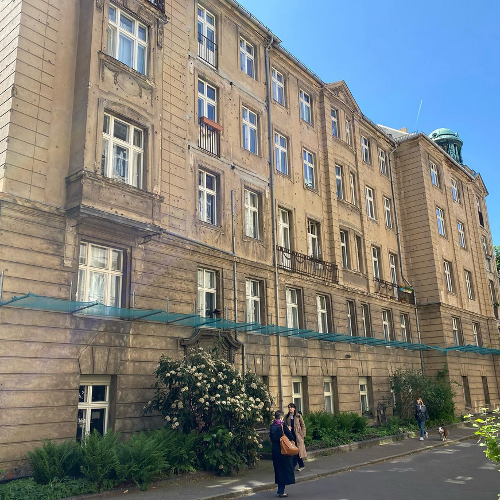
Look closely. Here, at the Sophienkirche parish hall, you can still see them—
the bullet holes from the final days of the Second World War. Silent witnesses
in stone. On April 24, 1945, fierce fighting raged right here on Große Hamburger Straße:
on one side, the advancing Red Army; on the other, the
Wehrmacht, SS, and Volkssturm. Houses were turned into fortresses; every meter
became a deadly zone. These scars do not fit into the modern, hip Berlin—yet
they speak of death and suffering. That is why they should remain. They serve as
both a warning and a memorial.
The Sophienkirche itself has seen a great deal. Before the war, it was the heart
of the Sophien congregation—surrounded by small artisan workshops, Jewish
businesses, and the narrow alleys of the Scheunenviertel district. Unlike many churches
in Berlin, it survived the nights of bombing almost unscathed—perhaps because
its Baroque spire has towered over the neighborhood like a silent guardian
since 1713.
Nearly twenty years after the end of the war, it once again became a stage for
history. On September 13, 1964, the American civil rights leader Martin
Luther King was visiting West Berlin. Unexpectedly, he crossed through the Wall into the
eastern sector of the city—without an official visa—to preach right here,
at the Sophienkirche. The news spread like wildfire. 3,000 people
flocked to the church, though only 1,500 could find a seat. Inside, King spoke of walls—
not of concrete, but of those within people’s hearts. His words gave hope to many
at a time when the division seemed insurmountable.
Following King’s visit, the Sophienkirche remained a special place within the GDR. Under the watchful eyes of the state authorities, it evolved during the 1970s and 80s into a gathering place for Christians, artists, and dissidents. Peace prayers, concerts, and exhibitions took place here—events that would have been all but impossible officially. Until the fall of the Berlin Wall in 1989, the church remained a quiet yet steadfast place of resistance—and of hope.
As you stand here, you can sense these layers of history: the struggles of 1945, life in the pre-war neighborhood, King’s courageous sermon during the Cold War—and the years of quiet resistance that followed. All of this, in a single place.
-
Image: Sophienkirche Parish Hall, own work
-
Image: By Berlinspaziergang – Own work, CC BY-SA 4.0, https://commons.wikimedia.org/w/index.php?curid=105041593
-
Image: By OTFW, Berlin – Self-photographed, CC BY-SA 3.0, https://commons.wikimedia.org/w/index.php?curid=28793233