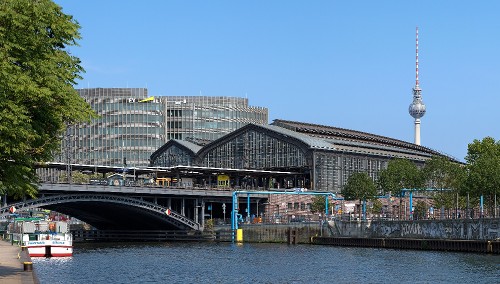
Welcome to Friedrichstraße Station!
Look around—you are standing in a place full of stories.
Here, East and West—freedom and control, separation and longing—once intersected.
Imagine this: the station opened in 1882.
Initially serving suburban trains, it later became a stop for long-distance trains bound for Leipzig, Hamburg, and Dresden. The railway brought people from all over Germany—and even from abroad.
Even back then, the station was a major transport hub right in the heart of Berlin.
After World War II, the station found itself situated within the Soviet sector.
Yet long-distance train services continued to run here—and, starting in August 1961, the border between East and West—the Berlin Wall—ran right through this very spot.
West Berliners, East Berliners, travelers from all over the world: everyone had to pass through strict checkpoints. The platforms and halls were partitioned—each area strictly segregated.
You can picture it as a vast labyrinth, filled with walls, barriers, and inspectors at every turn.
In 1962, the Tränenpalast (Palace of Tears) was built right next to the station.
A modern pavilion constructed of glass and steel.
This was where you had to undergo passport control and customs inspection if you wished to leave the GDR or were arriving from West Berlin.
Many people here experienced tearful farewells—parting from family, friends, and loved ones. That is why people came to call it the Tränenpalast.
Imagine people standing here, bidding one another farewell—often without knowing
when, or if, they would ever see each other again.
The station itself remained a vital hub for long-distance travel:
From here, trains departed for Leipzig, Dresden, Hamburg—and even Moscow.
But everything remained segregated: East-bound trains, West-bound trains, S-Bahn commuter lines, and U-Bahn subway lines—all operating on different levels.
Friedrichstraße Station was, in a sense, a “three-dimensional border crossing.”
On November 9, 1989, the Wall fell.
Suddenly, every door stood open.
The checkpoints were dismantled, and the dividing walls vanished. Trains once again travel freely through Berlin, and the Tränenpalast loses its original function.
Today, the Tränenpalast serves as a memorial site.
The permanent exhibition reveals what life during the Cold War was like—the surveillance, the farewells, and the longing for freedom.
The station itself has been modernized; today, it serves regional trains, the S-Bahn, and the U-Bahn.
Yet as you stand here, you can still feel the history.
The walls, the corridors, the tracks—they tell a story of separation and reunification.
Friedrichstraße Station and the Tränenpalast—two places that demonstrate the intensity with which people can experience longing and hope.
And how railways and glass can become witnesses to history.
Image 1: By Christian Wolf (www.c-w-design.de), CC BY-SA 3.0 de, https://commons.wikimedia.org/w/index.php?curid=43162162
Image 2:
South side of the station, circa 1885. By unknown author – Photo archives of the Prussian Heritage Foundation. Scanned from Janos Frecot & Helmut Geisert: Berlin in frühen Photographien 1857–1913. Schirmer/Mosel, Munich 1984. ISBN 3-88814-984-3. Public domain, https://commons.wikimedia.org/w/index.php?curid=3211955
Image 3: North side of the railway station, 1926, following the renovation. By unknown author – http://www.snugu.de/ak/berlinfriedrichstr.htm. Public domain, https://commons.wikimedia.org/w/index.php?curid=101295
Image 4: By Bundesarchiv, Image 183-C1031-0044-009 / Spremberg, Joachim / CC-BY-SA 3.0. CC BY-SA 3.0 de, https://commons.wikimedia.org/w/index.php?curid=5432931
Image 5: By Riki1979 on the German Wikipedia – Self-photographed! Transferred from de.wikipedia to Commons by Wdwd using CommonsHelper. Public domain, https://commons.wikimedia.org/w/index.php?curid=15778545