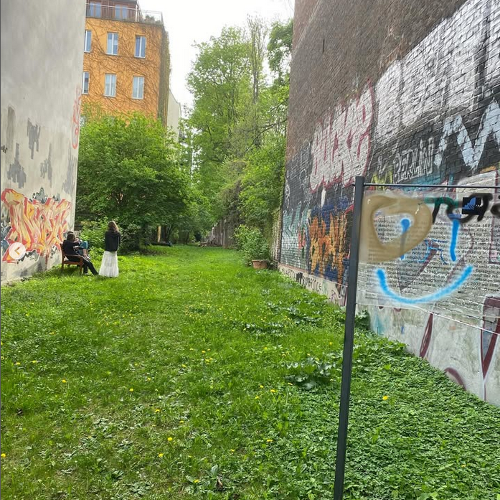
You are now standing at the Judengang—the “Jews’ Walk”—an unassuming, narrow path. Yet, it serves as a key to the history of Jewish life in Prenzlauer Berg.
In the 19th century, Berlin’s Jewish community grew significantly. Many families moved into the burgeoning neighborhoods situated beyond the old city walls. Prenzlauer Berg, too, became a hub of Jewish life: schools, shops, and—later—the grand synagogue on Rykestraße opened here. Upon its completion in 1904, this synagogue was the largest in Germany—a symbol of self-confidence and belonging.
However, decades earlier, the Jewish Cemetery on Schönhauser Allee had already been established. You can see the cemetery wall behind you, to the right. It opened in 1827, as the old burial ground in the Mitte district had become too small. Spanning just under five hectares, the site became the final resting place for over 20,000 people. The cemetery bears witness to the social ascent of Jewish families during the 19th century: simple headstones stand alongside magnificent mausoleums, and German inscriptions appear alongside Hebrew ones.
Many prominent figures rest here: the composer Giacomo Meyerbeer, the banker Gerson von Bleichröder, the publisher Leopold Ullstein, and the painter Max Liebermann. These names represent the realms of art, music, business, and academia—embodying the legacy that Jewish citizens built in Berlin.
And what of the Judengang itself? Its origins are linked to the Prussian King Frederick William III. He frequently traveled along Schönhauser Allee on his way to his palace in Schönhausen. However, he wished to avoid encountering any Jewish funeral processions during his journeys. Consequently, a rear entrance was created for mourners at what is now 41 Knaackstraße. From there, this narrow path—stretching nearly four hundred meters—led directly to the cemetery. Thus the Judengang came into being—
a path of mourning, of seclusion, but also of dignity.
The Jewish Cemetery was closed in 1880, when the new one in Weißensee was opened.
Yet many families continued to use their family plots here. During the era of
National Socialism, the cemetery remained largely intact—unlike many synagogues,
which were destroyed. After the war, it was a quiet place, almost forgotten. It was not until the
1970s that it was placed under heritage protection, and in 2002, the Judengang was once again
made accessible—albeit only as part of guided tours.
Today, this path stands as a memorial. It serves as a reminder of splendor and of everyday life,
of integration and of persecution. And it reminds us just how closely joy and sorrow, life
and death, acceptance and exclusion lie side by side.
Jews' Passage
from the audio walk Berlin Like You’ve Never Heard It Before – True Stories & Secrets

254:05 min Audio
8
Listen to the audio tour now - ideally in full screen view.
Or use the app for listening to the audio walk on site:


Other stops on this audio tour:
A Brief Excursion into Berlin's History (7:59 min) • St. Nicholas' Church / St. Nicholas' Quarter (2:49 min) • Newspaper District (4:28 min) • Checkpoint Charlie (1:55 min) • Former Gestapo Headquarters (2:57 min) • Former Tempelhof Airport (3:46 min) • 7 Wannsee Conference (4:45 min) • Walther Rathenau Memorial (2:34 min) • Olympic Stadium / 1936 Olympic Games (5:36 min) • Commune 1 (2:27 min) • Benno Ohnesorg / Student Movement (2:16 min) • Rolf Eden (1:54 min) • Café Kranzler (2:08 min) • Kurfürstendamm (3:03 min) • Zoo Palace (3:47 min) • Kaiser Wilhelm Memorial Church (2:22 min) • Karl Liebknecht and Rosa Luxemburg (3:28 min) • Schöneberg Town Hall (2:33 min) • Former Sportpalast / Sportpalast Speech (5:12 min) • Bendlerblock/Stauffenberg assassination attempt (4:47 min) • Kroll Opera House / Enabling Act (3:09 min) • Reichstag Building (4:14 min) • Reichstag Fire (4:28 min) • Brandenburg Gate (2:52 min) • People's Court (3:08 min) • Potsdamer Place (2:58 min) • Former "Führerbunker" (5:06 min) • "Tresor" (Safe) (1:43 min) • Popular Uprising in the GDR (2:11 min) • Reich Chancellery / Hitler's Seizure of Power (5:11 min) • "Die weiße Maus" (The White Mouse) (2:57 min) • Friedrichstraße Station / "Tränenpalast" (Palace of Tears) (3:46 min) • Humboldt University (1:56 min) • Berlin Palace (5:04 min) • Red City Hall (2:30 min) • Alexanderplatz (2:30 min) • Otto Weidt's Workshop for the Blind / Anne Frank Center (2:05 min) • Hackesche Höfe (5:21 min) • Rosenthaler Platz (2:58 min) • St. Sophia's Church (3:03 min) • Sophie-Gips Courtyards (2:08 min) • Koppenplatz (3:16 min) • Clärchen's Dance Hall (3:54 min) • New Synagogue (2:19 min) • Berliner Ensemble (3:55 min) • Friedrichstadt-Palast (4:02 min) • Dorotheenstadt Cemetery (2:25 min) • Bloody May (2:18 min) • Humboldthain Flak Tower (5:17 min) • Chris Gueffroy and the Victims of the Wall (1:28 min) • Tunnel 57 / Egon Schultz (2:40 min) • AMIGA (1:37 min) • Bernauer Street (4:07 min) • Former Bornholmer Straße Border Crossing (3:26 min) • Friedrich-Ludwig-Jahn Sports Park (3:43 min) • Mauerpark (4:07 min) • Arkonaplatz (3:03 min) • Zion Church (3:44 min) • Prenzlauer Berg Fire Station (3:18 min) • Hirschhof (2:41 min) • Freya Klier (2:28 min) • Prater (2:28 min) • Oderberger Straße Municipal Baths (3:36 min) • Oderberger Street 2 (1:58 min) • Currywurst (2:16 min) • Konnopke's Snack Bar (2:43 min) • Gethsemane Church (2:09 min) • Museum in the Kulturbrauerei (1:06 min) • Kulturbrauerei (3:24 min) • Frannz-Club (2:31 min) • Husemann Street (1:58 min) • Prenzlauer Berg Water Tower (2:37 min) • Rosa Luxemburg Square (4:34 min) • Mont Klamott (1:43 min) • Samaritan Church (2:23 min) • Former Stasi Headquarters / Stasi Museum (2:48 min) • Berlin-Karlshorst Museum / Unconditional Surrender (2:54 min) • East Side Gallery (2:59 min) • House Squatting in the 1980s (2:34 min)