Welcome to Berlin’s Newspaper Quarter. You are standing here at a place that was once the heart of the German press landscape—a place full of energy, full of words, full of history.
Beginning in the mid-119th century, the great publishing houses moved in here: Ullstein, Mosse, Scherl—names that soon became known throughout Germany. Before long, millions of copies were being printed here. In the 1920s, more than 140 newspapers and magazines were published in this district—more than anywhere else in Europe. The streets were loud, hectic, and vibrant. Everywhere, one could hear the clatter of printing presses, smell the printer’s ink, and see the headlines at the newsstands just moments after editorial deadline.
Yet this district was not merely a place of journalism; it was also a place of politics, of struggles, and of conflict.
In January 1919—amidst the revolution following the First World War—the Spartacist Uprising broke out here.
Armed workers occupied the publishing houses, demanding a free press, a better system, and a more just world. Fierce fighting erupted in the streets; even the famous Mosse House was struck. The district became the stage for a
dramatic chapter in the early Weimar Republic—an uprising that was brutally suppressed.
Then, in 1933, came the next turning point: the National Socialists’ seizure of power. The free press was brought into line (Gleichschaltung); Jewish publishers, such as the Mosse family, were dispossessed, persecuted, or forced to flee into exile. The Ullstein publishing house, too, was “Aryanized.” A place once defined by a diversity of opinion was transformed into a place of propaganda. Instead of critical voices, party newspapers—such as the Völkischer Beobachter—now held sway. The Newspaper Quarter—once a symbol of democracy—had become an instrument of dictatorship.
During the Second World War, Allied air raids destroyed large parts of the district. Many of the publishing houses lay in ruins. The story seemed to be over.
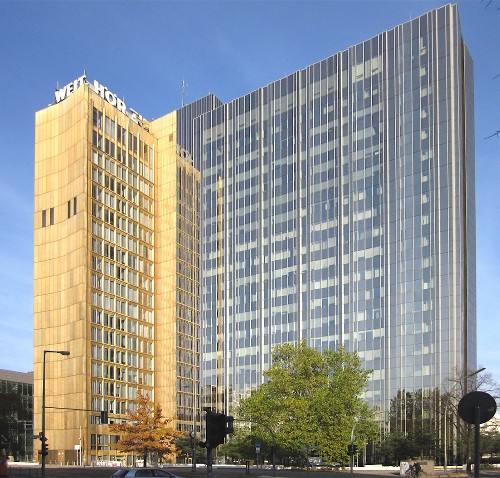
Yet with the construction of the Axel Springer high-rise—erected directly alongside the Wall—press freedom returned to the western part of the district in the 1950s and 60s, serving as a symbol against the GDR dictatorship and in support of free reporting. However, this very new building later became a target of the 1968 movement. Students accused Springer of contributing to inflammatory rhetoric through newspapers such as Bild—particularly in the wake of the assassination attempt on Rudi Dutschke. Fierce protests, demonstrations, and riots erupted in the vicinity of the publishing house.
The Newspaper District thus once again became a political flashpoint—this time within the context of the Cold War.
Today, things have grown quieter. Some publishers, such as taz, have returned, and new structures now stand on historic ground. Yet the stories remain: stories of the rise of the press, of courageous journalists, of censorship and resistance, of uprisings, propaganda, and protest.
The Newspaper District tells not only the history of the media; it tells a history of power—and serves as a reminder of just how vital a free press is to democracy.
The Newspaper District is located roughly between Leipziger Straße and Mehringplatz, bounded by Wilhelmstraße and Lindenstraße.
Image 1:
The Axel Springer Building in Berlin. By Jörg Zägel – Own work, CC BY-SA 3.0, https://commons.wikimedia.org/w/index.php?curid=11921322