Right in the heart of Berlin’s Mitte district—situated directly alongside the Volksbühne and the Babylon Cinema—lies a square that is more than just a place to linger: Rosa-Luxemburg-Platz. Standing there today, one sees modern architecture, a cinema steeped in tradition, and a theater with a rich history. Yet beneath the surface, this square tells a story of revolution, power, art, and memory—of all the elements that defined Berlin throughout the 20th century.
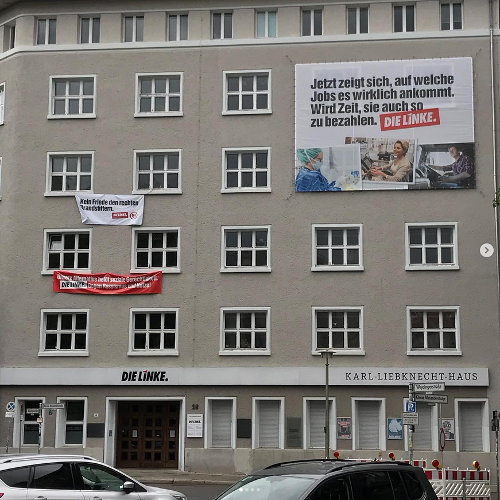
In earlier times, this area was home to the Scheunenviertel—a poor, densely built-up quarter where many Jewish families lived. A major transformation began in 1907: the district was demolished, and a new urban square took its place. It was initially named Babelsberger Platz, and later Bülowplatz. In the 1920s, it evolved into a political flashpoint. It was here that the Communist Party established its headquarters—the Karl-Liebknecht-Haus—which is today utilized by the party Die Linke. Just a few steps away, the Volksbühne opened its doors in 1914—a theater for the working people: radical, socially conscious, and politically engaged.
In 1929, a distinctive building was added to the site: the Babylon Cinema, designed by the renowned architect Hans Poelzig. At the time, it was one of the most modern cinemas in the city, featuring an orchestra pit, a cinema organ, and impressive acoustics. This organ has survived to this day—remaining Germany’s only original silent-film organ still located at its original site—and is regularly played live during silent-film screenings.
However, the political tensions of that era left their mark. In 1931, two police officers were shot dead nearby by members of the KPD—one of the perpetrators was Erich Mielke, who would later go on to become the head of the Stasi. When the National Socialists came to power in 1933, they renamed the
square Horst-Wessel-Platz, occupied the Karl-Liebknecht-Haus, and erected
propaganda monuments. The site became a stage for the Nazi regime—until Berlin
was engulfed in a hail of bombs during the Second World War.
After the war ended, a new era began. In the GDR, the square was first named Liebknechtplatz,
then Luxemburgplatz, and finally, in 1969, officially became what it is today: Rosa-
Luxemburg-Platz, named after the leftist revolutionary who was murdered in 1919. The
Volksbühne reopened in 1954 and evolved into one of the most important
theaters in the GDR—and later in reunified Berlin as well. The Babylon cinema
screened Soviet films, then DEFA documentaries, and was extensively
restored in 2001—an achievement recognized with a heritage preservation award.
Today, Babylon is a venue for cinematic art, festivals, silent film concerts, and political
remembrance. A plaque in the foyer commemorates the projectionist Rudolf Lunau, who
founded a resistance group against the Nazis there in 1933. On the square itself, one can find an
artwork by the artist Hans Haacke: 60 concrete beams engraved with quotes by Rosa
Luxemburg, embedded between the theater, the street, and the sidewalk. They invite
reflection—on freedom, responsibility, and the value of democracy.
Rosa-Luxemburg-Platz is not merely a place where history happened. It lives
history—through its buildings, its past, and the people who breathe new life into it
every day. Those who stand here stand on ground steeped in great ideas and profound
conflicts. And they sense: Berlin forgets nothing—it tells stories. Image 1:
Former Karl Liebknecht House, today the headquarters of the party “Die Linke”
Image 2:
By Bundesarchiv, Image 183-C00678 / CC-BY-SA 3.0, CC BY-SA 3.0 de,
https://commons.wikimedia.org/w/index.php?curid=5360897
Image 3:
Volksbühne, Photo by: Andreas Praefcke – Self-photographed, CC BY 3.0,
https://commons.wikimedia.org/w/index.php?curid=98459
Image 4:
Kino Babylon, Photo by: Andreas Praefcke – Own work, CC BY 3.0,
https://commons.wikimedia.org/w/index.php?curid=98200
Rosa Luxemburg Square
from the audio walk Berlin Like You’ve Never Heard It Before – True Stories & Secrets

254:05 min Audio
8
Listen to the audio tour now - ideally in full screen view.
Or use the app for listening to the audio walk on site:


Other stops on this audio tour:
A Brief Excursion into Berlin's History (7:59 min) • St. Nicholas' Church / St. Nicholas' Quarter (2:49 min) • Newspaper District (4:28 min) • Checkpoint Charlie (1:55 min) • Former Gestapo Headquarters (2:57 min) • Former Tempelhof Airport (3:46 min) • 7 Wannsee Conference (4:45 min) • Walther Rathenau Memorial (2:34 min) • Olympic Stadium / 1936 Olympic Games (5:36 min) • Commune 1 (2:27 min) • Benno Ohnesorg / Student Movement (2:16 min) • Rolf Eden (1:54 min) • Café Kranzler (2:08 min) • Kurfürstendamm (3:03 min) • Zoo Palace (3:47 min) • Kaiser Wilhelm Memorial Church (2:22 min) • Karl Liebknecht and Rosa Luxemburg (3:28 min) • Schöneberg Town Hall (2:33 min) • Former Sportpalast / Sportpalast Speech (5:12 min) • Bendlerblock/Stauffenberg assassination attempt (4:47 min) • Kroll Opera House / Enabling Act (3:09 min) • Reichstag Building (4:14 min) • Reichstag Fire (4:28 min) • Brandenburg Gate (2:52 min) • People's Court (3:08 min) • Potsdamer Place (2:58 min) • Former "Führerbunker" (5:06 min) • "Tresor" (Safe) (1:43 min) • Popular Uprising in the GDR (2:11 min) • Reich Chancellery / Hitler's Seizure of Power (5:11 min) • "Die weiße Maus" (The White Mouse) (2:57 min) • Friedrichstraße Station / "Tränenpalast" (Palace of Tears) (3:46 min) • Humboldt University (1:56 min) • Berlin Palace (5:04 min) • Red City Hall (2:30 min) • Alexanderplatz (2:30 min) • Otto Weidt's Workshop for the Blind / Anne Frank Center (2:05 min) • Hackesche Höfe (5:21 min) • Rosenthaler Platz (2:58 min) • St. Sophia's Church (3:03 min) • Sophie-Gips Courtyards (2:08 min) • Koppenplatz (3:16 min) • Clärchen's Dance Hall (3:54 min) • New Synagogue (2:19 min) • Berliner Ensemble (3:55 min) • Friedrichstadt-Palast (4:02 min) • Dorotheenstadt Cemetery (2:25 min) • Bloody May (2:18 min) • Humboldthain Flak Tower (5:17 min) • Chris Gueffroy and the Victims of the Wall (1:28 min) • Tunnel 57 / Egon Schultz (2:40 min) • AMIGA (1:37 min) • Bernauer Street (4:07 min) • Former Bornholmer Straße Border Crossing (3:26 min) • Friedrich-Ludwig-Jahn Sports Park (3:43 min) • Mauerpark (4:07 min) • Arkonaplatz (3:03 min) • Zion Church (3:44 min) • Prenzlauer Berg Fire Station (3:18 min) • Hirschhof (2:41 min) • Freya Klier (2:28 min) • Prater (2:28 min) • Oderberger Straße Municipal Baths (3:36 min) • Oderberger Street 2 (1:58 min) • Currywurst (2:16 min) • Konnopke's Snack Bar (2:43 min) • Gethsemane Church (2:09 min) • Museum in the Kulturbrauerei (1:06 min) • Kulturbrauerei (3:24 min) • Frannz-Club (2:31 min) • Husemann Street (1:58 min) • Jews' Passage (3:32 min) • Prenzlauer Berg Water Tower (2:37 min) • Mont Klamott (1:43 min) • Samaritan Church (2:23 min) • Former Stasi Headquarters / Stasi Museum (2:48 min) • Berlin-Karlshorst Museum / Unconditional Surrender (2:54 min) • East Side Gallery (2:59 min) • House Squatting in the 1980s (2:34 min)