Imagine standing at a place where, at one time, the world’s largest aircraft took off.
Where heads of state landed, children scanned the skies for “Raisin Bombers,” and where the largest airport building on Earth was once constructed.
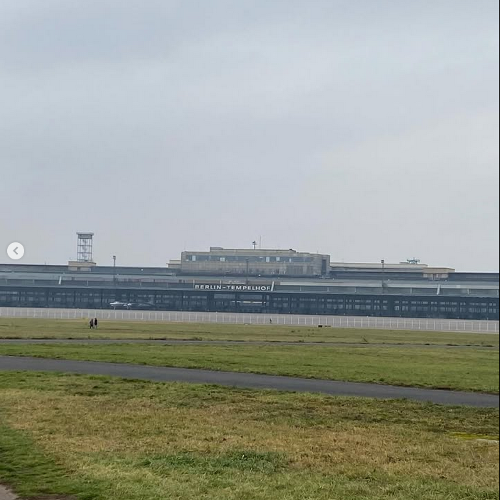
This is Tempelhof Airport—a place where nearly a century of Berlin and world history unfolded.
Its history begins on October 8, 1923. Back then, only a few aircraft took off from here—primarily mail flights and the first passenger connections within Germany. Yet the Tempelhofer Feld—a vast, open expanse in the heart of Berlin—was perfect for aviation. It soon became clear: something monumental was going to take shape here. In 1927, the first large stone hangars were built; in 1929, an expanded terminal building followed. In the late 1920s and early 1930s, Tempelhof was one of the most modern airports in Europe—a symbol of progress, technology, and international connectivity. The oval shape of the airfield allowed for takeoffs and landings in any direction, regardless of how the wind was blowing.
With the National Socialists’ rise to power, everything changed. Beginning in the mid-1930s, they embarked on a reconstruction project on a gigantic scale. By 1941, the 1.2-kilometer-long airport building had been completed—at the time, the largest in the world. The airfield was expanded to a width of two kilometers to accommodate civilian flights, massive propaganda rallies, and military operations. From 1939 onward, approximately 2,000 forced laborers were compelled to assemble warplanes here. Toward the end of the Second World War, civilian air traffic ground to an almost complete halt—fuel supplies ran dry, and
Allied bombing raids intensified. Finally, Soviet
troops occupied the site.
On July 4, 1945, the Allies took control of the airport, and the U.S. Army established its base there. Civilian flights resumed as early as 1946.
Tempelhof achieved worldwide fame during the Berlin Airlift of 1948–49, when the Russians blocked all land and water routes into West Berlin. Day after day, the so-called “Raisin Bombers” brought food, coal, and sweets into the city. For many West Germans during the Cold War, Tempelhof was the gateway to Berlin—accessible only via Allied aircraft, never on a German airline.
In 1975, Tegel took over major passenger traffic, while Tempelhof remained dedicated to business flights and private aircraft. Following the withdrawal of the Allied forces in 1993, it continued to be used as a short-haul airport. However, on October 31, 2008, the engines fell silent forever. Today, Tempelhofer Feld is a vast public
park—a place for kites, bicycles, and leisurely strolls. Yet anyone standing here can still feel the winds of history that have swept across this field.
Image 1: Own work
Image 2: Own work
Image 3: Own work
Image 4: By Unknown author – This file is a cropped section of another file; Public Domain; https://commons.wikimedia.org/w/index.php?curid=138607468
Image 5: By Wald-Burger8 – Own work; CC BY-SA 3.0; https://commons.wikimedia.org/w/index.php?curid=27854406
Image 6: By USAF – National Museum of the U.S. Air Force photo 050421-F-1234P-016; Public Domain; https://commons.wikimedia.org/w/index.php?curid=30479085
Image 7: By U.S. Air Force – U.S. Navy National Museum of Naval Aviation photo No. 2000,043,012; National Museum of the U.S. Air Force photo 050426-F-1234P-008, Public Domain, https://commons.wikimedia.org/w/index.php?curid=3552352
Image 8: By Henry Ries / USAF - Library of Congress, “Berlin “Airlift” of 1948-1949 broke through Soviet blockade of the city by non-stop supply shipments to beleaguered garrisons and 2 1/4 million civilian population of West Berlin”, CPH: 3c36389 [1], public domain, https://commons.wikimedia.org/w/index.php?curid=4559179