language

Berliner Ensemble

from the audio walk Berlin Like You’ve Never Heard It Before – True Stories & Secrets

Berlin Like You’ve Never Heard It Before – True Stories & Secrets
80 Stations
254:05 min Audio
directions_railway favorite 8
Berliner Ensemble

Berlin, 1949.
The city lies in rubble and ashes. Yet, amidst the chaos, it is not a new weapon that emerges—
but a theater.
Not for dreaming.
But for waking up.
The Berliner Ensemble.
In 1949, the renowned playwright Bertolt Brecht and his wife, the
actress Helene Weigel, founded this theater in East Berlin. Their vision? Theater that
does not merely entertain—but rouses, enlightens, and transforms. Politics on stage. Striking
right at the heart.
Supported with benevolence by the SED, as well as GDR President Wilhelm Pieck and GDR
Head of Government Otto Grotewohl.
Initially, the ensemble performed at the Deutsches Theater, but before long, it acquired
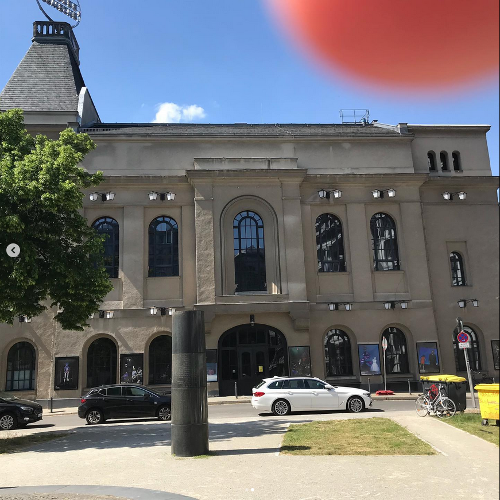
a home of its own: starting in 1954, the Theater am Schiffbauerdamm—a magnificent edifice situated
directly on the Spree River. It was there, years earlier, that Brecht’s The Threepenny Opera had
celebrated its premiere.
Ever since, the plays performed there have constituted socially relevant, political, and critical theater.

The era under Brecht’s direction was unique. Rehearsals lasted for weeks—even months. Every detail
had to be perfect. And so that other directors could precisely recreate his productions, Brecht commissioned the creation of so-called “model books”—containing hundreds of photographs of every scene.
The ensemble rose to fame with plays such as Mother Courage and Her Children, The Life of Galileo, and The Caucasian Chalk Circle. Always at the forefront were powerful actors like Helene Weigel, Ekkehard Schall, and Erwin Geschonneck. They were not stars basking in the limelight; they were part of a grand idea.
After Brecht’s death in 1956, his wife took over the leadership. And even in the years that followed, the Berliner Ensemble remained a place of experimentation. Particularly under the direction of Ruth Berghaus in the 1970s, the theater became wild, innovative, and unconventional—qualities that did not appeal to everyone.
Later, following the reunification of Germany, the theater underwent a major restructuring. The great playwright Heiner Müller assumed the directorship, guiding the ensemble into the new Germany with powerful, politically charged productions.
From 1999 to 2017, Claus Peymann left his indelible mark on the ensemble. His productions were provocative and astute—always a little bit uncomfortable. Since 2017, Oliver Reese has led the institution. He brings new texts, modern directorial approaches, and digital formats to the stage—yet always with the spirit of Brecht standing behind him.
And today? The ensemble shines with a new generation of actors. They breathe new life into the classics and bring fresh, contemporary texts to the stage.
The Berliner Ensemble is more than just a theater. It is a place where history remains alive—a place where actors do not merely perform, but take a stand. It is a place where you do not simply watch, but think along, feel along, and engage in the debate.
A theater that does not merely reach your ears—but gets under your skin.


Listen to the audio tour now - ideally in full screen view.

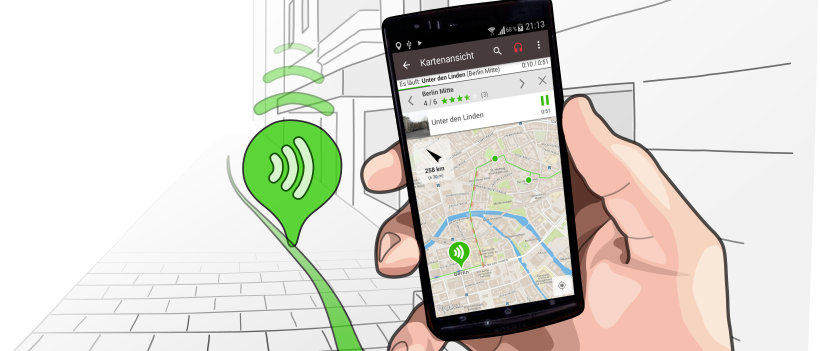
Or use the app for listening to the audio walk on site:

1
Install guidemate app Available in the app & play stores.
2
Open audio guide (in installed app) More guides available
3
Start the tour on site! Audio, map & infos - also available offline.

Other stops on this audio tour:

A Brief Excursion into Berlin's History (7:59 min) • St. Nicholas' Church / St. Nicholas' Quarter (2:49 min) • Newspaper District (4:28 min) • Checkpoint Charlie (1:55 min) • Former Gestapo Headquarters (2:57 min) • Former Tempelhof Airport (3:46 min) • 7 Wannsee Conference (4:45 min) • Walther Rathenau Memorial (2:34 min) • Olympic Stadium / 1936 Olympic Games (5:36 min) • Commune 1 (2:27 min) • Benno Ohnesorg / Student Movement (2:16 min) • Rolf Eden (1:54 min) • Café Kranzler (2:08 min) • Kurfürstendamm (3:03 min) • Zoo Palace (3:47 min) • Kaiser Wilhelm Memorial Church (2:22 min) • Karl Liebknecht and Rosa Luxemburg (3:28 min) • Schöneberg Town Hall (2:33 min) • Former Sportpalast / Sportpalast Speech (5:12 min) • Bendlerblock/Stauffenberg assassination attempt (4:47 min) • Kroll Opera House / Enabling Act (3:09 min) • Reichstag Building (4:14 min) • Reichstag Fire (4:28 min) • Brandenburg Gate (2:52 min) • People's Court (3:08 min) • Potsdamer Place (2:58 min) • Former "Führerbunker" (5:06 min) • "Tresor" (Safe) (1:43 min) • Popular Uprising in the GDR (2:11 min) • Reich Chancellery / Hitler's Seizure of Power (5:11 min) • "Die weiße Maus" (The White Mouse) (2:57 min) • Friedrichstraße Station / "Tränenpalast" (Palace of Tears) (3:46 min) • Humboldt University (1:56 min) • Berlin Palace (5:04 min) • Red City Hall (2:30 min) • Alexanderplatz (2:30 min) • Otto Weidt's Workshop for the Blind / Anne Frank Center (2:05 min) • Hackesche Höfe (5:21 min) • Rosenthaler Platz (2:58 min) • St. Sophia's Church (3:03 min) • Sophie-Gips Courtyards (2:08 min) • Koppenplatz (3:16 min) • Clärchen's Dance Hall (3:54 min) • New Synagogue (2:19 min) • Friedrichstadt-Palast (4:02 min) • Dorotheenstadt Cemetery (2:25 min) • Bloody May (2:18 min) • Humboldthain Flak Tower (5:17 min) • Chris Gueffroy and the Victims of the Wall (1:28 min) • Tunnel 57 / Egon Schultz (2:40 min) • AMIGA (1:37 min) • Bernauer Street (4:07 min) • Former Bornholmer Straße Border Crossing (3:26 min) • Friedrich-Ludwig-Jahn Sports Park (3:43 min) • Mauerpark (4:07 min) • Arkonaplatz (3:03 min) • Zion Church (3:44 min) • Prenzlauer Berg Fire Station (3:18 min) • Hirschhof (2:41 min) • Freya Klier (2:28 min) • Prater (2:28 min) • Oderberger Straße Municipal Baths (3:36 min) • Oderberger Street 2 (1:58 min) • Currywurst (2:16 min) • Konnopke's Snack Bar (2:43 min) • Gethsemane Church (2:09 min) • Museum in the Kulturbrauerei (1:06 min) • Kulturbrauerei (3:24 min) • Frannz-Club (2:31 min) • Husemann Street (1:58 min) • Jews' Passage (3:32 min) • Prenzlauer Berg Water Tower (2:37 min) • Rosa Luxemburg Square (4:34 min) • Mont Klamott (1:43 min) • Samaritan Church (2:23 min) • Former Stasi Headquarters / Stasi Museum (2:48 min) • Berlin-Karlshorst Museum / Unconditional Surrender (2:54 min) • East Side Gallery (2:59 min) • House Squatting in the 1980s (2:34 min)


Tours

Search Redeem voucher Audio tours by city Location-independent audio tours Blog

Account

Register

Support

FAQ Guide to guide

About us

Prices and conditions Affiliate Program Press info Technology Terms and conditions Privacy Legal notice