It is a cold Monday evening in Berlin.
February 27, 1933.
The streets are dark. It is quiet… almost too quiet.
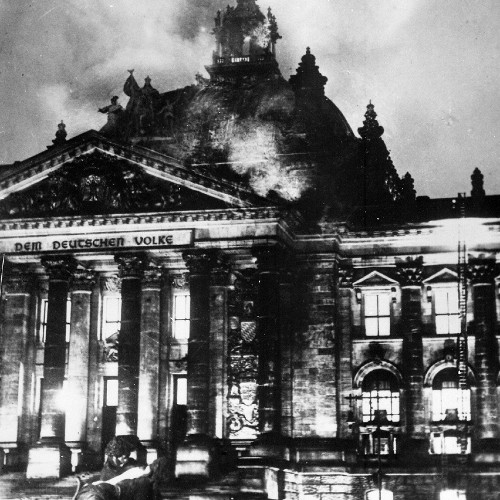
Then—suddenly—a blinding glare of fire breaks through the night.
Flames leap from the windows of the Reichstag. Smoke rises into the sky. People stop in their tracks, gazing in horror at the burning heart of German democracy.
The Reichstag—the symbol of the Weimar Republic—is engulfed in flames.
That very night, a man is arrested inside the building: Marinus van der Lubbe, a 24-year-old Dutchman. He was a former construction worker with ties to leftist groups,
yet he was acting alone. He confesses immediately: “I set the fire.” Why? He says he wanted to make a statement—against the injustice within the state and on behalf of the workers.
But the new government under Adolf Hitler does not believe him—or chooses not to believe him.
Hitler had become Reich Chancellor just four weeks earlier. Now he claims: “This was an attack by the Communists! They are plotting an uprising!” Immediately, a massive
wave of arrests begins. Thousands of people—primarily Communists—are detained, without a shred of evidence.
The very next day—February 28, 1933—a new emergency decree is issued. Officially titled the “Decree for the Protection of People and State,”
in reality, it signifies the exact opposite:
Citizens are no longer free to express their opinions. Newspapers are no longer permitted to publish freely. The police and the SA are empowered to search homes and imprison individuals—without a court warrant.
This decree remains in force until 1945; it marks the dawn of the dictatorship.
Thus, the Nazis did not merely exploit the fire for propaganda purposes; they twisted the event into a pretext to dismantle democracy itself. Shortly thereafter, the first concentration camps were established—most notably at Dachau. There, political opponents were imprisoned, tortured, and, in some cases, murdered. In September 1933, the great Reichstag Fire Trial began. Alongside van der Lubbe, four other men stood accused—including three Bulgarian communists and a German member of parliament from the KPD. One of them, Georgi Dimitrov, chose to defend himself. He was intelligent, courageous—and even managed to put the Nazis on the defensive. In court, he publicly challenged Hermann Göring, one of the most powerful figures in the Nazi regime. Newspapers around the world reported on his speeches; he became a symbol of resistance.
Ultimately, in December 1933, the court found van der Lubbe guilty. He was sentenced to death and executed in January 1934. The other defendants were acquitted—a setback for the Nazi leadership.
To this day, there is debate as to whether van der Lubbe truly acted alone. Most historians say yes: all the evidence suggests that it was indeed him—acting entirely on his own. But regardless of who actually set the fire, the National Socialists exploited the event to consolidate their power and eliminate their political opponents.
The Reichstag Fire marked a turning point. Democracy gave way to dictatorship. Within a matter of weeks, fundamental rights were abolished, people were arrested, and an entire country was transformed—through fear, lies, and violence.
Today, the reconstructed Reichstag stands as a reminder of the vital importance of freedom, democracy, and the rule of law—and of how quickly they can be lost.
Image 1: By Unknown Author – This tag does not indicate the copyright status of the accompanying work. A standard license template is required in addition to this tag in all cases. See Commons:Licensing for more information. Public Domain. https://commons.wikimedia.org/w/index.php?curid=19482634
Image 2: By Robert Sennecke – http://www.artnet.com/artists/lotdetailpage.aspx?lot_id=0803704DAC0AFFE3; Information source: https://www.europeana.eu/de/item/08547/sgml_eu_php_obj_bb049239, Public Domain, https://commons.wikimedia.org/w/index.php?curid=15036044
Image 3: By Unknown photographer – GaHetNa (Nationaal Archief, The Netherlands), Nationaal Archief at archive.org, Public Domain, https://commons.wikimedia.org/w/index.php?curid=32216633