Imagine standing not merely in front of a building—but right in the midst of Germany’s history.
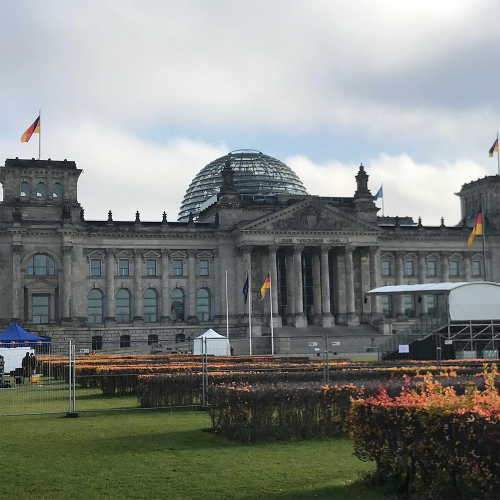
Before you stands the Reichstag building. It looks imposing—and indeed, it always has been.
It all began here in 1884. The Kaiser himself laid the cornerstone. The new parliament was to be grand, modern, and strong.
Construction took ten years. And when it finally opened in 1894, the entire nation marveled at it:
A glass-and-steel dome, marble halls, a vast plenary chamber. Democracy—or at least as much of it as was possible at the time—had found a home.
The years passed. Then, in 1918: Germany lost the First World War. The monarchy collapsed.
Philipp Scheidemann, a politician from the SPD, stepped out onto a balcony right here—on this very building. And he proclaimed:
“The old, rotten order has collapsed. Long live the German Republic!”
The cry echoed across the land. For the first time, Germany became a democracy. And the Reichstag building once again stood at its center.
But—not everyone wanted democracy.
Throughout the 1920s and early 30s, a political battle raged—in the streets, in the newspapers, and within the parliament itself. The National Socialists, under Hitler, loathed everything this building stood for.
And then—on the night of February 27, 1933: Fire!
The dome was engulfed in flames. The plenary chamber was destroyed.
The Nazis blamed the Communists—a mere pretext. The very next day, fundamental civil liberties were suspended. With that, democracy was abolished.
And the Reichstag building? It remained—but merely as an empty shell.
In 1945, at the end of the Second World War, the building lay in ruins. Fierce fighting raged around it.
The famous red flag on the roof, hoisted by Soviet soldiers—an image that would be seen around the world.
The war was over. Germany lay in rubble. And the Reichstag? It still stood—but barely. After the war, Germany is divided. West Berlin receives a new parliament, and Bonn becomes the capital.
The Reichstag remains standing, but—without function, without a dome, without representatives. For decades, it serves as a memorial—silent, blackened by fire, a symbol of the lost republic.
Then, in 1989: the Wall falls.
And soon it is decided: Berlin will once again be the capital. The Bundestag is to return—home.
British architect Norman Foster is commissioned to reimagine the building. And what emerges is unique: a modern, glass dome.
It demonstrates that power in this country belongs to the people. The representatives sit beneath it, while we—the citizens—look on.
In 1999, the Bundestag moves back in. The old building lives on—more modern than ever.
Today, the Reichstag is a place where decisions are made almost every day—regarding laws, lives, and the future.
But it is also a monument. To what once was. To what must never happen again. And to what is possible when people stand up for freedom and democracy.
A tip for you:
If you have the time, be sure to visit the dome. The view over Berlin—seen through glass, directly above the plenary chamber—is more than just a scenic outlook.
Reichstag Building
from the audio walk Berlin Like You’ve Never Heard It Before – True Stories & Secrets

254:05 min Audio
8
Listen to the audio tour now - ideally in full screen view.
Or use the app for listening to the audio walk on site:


Other stops on this audio tour:
A Brief Excursion into Berlin's History (7:59 min) • St. Nicholas' Church / St. Nicholas' Quarter (2:49 min) • Newspaper District (4:28 min) • Checkpoint Charlie (1:55 min) • Former Gestapo Headquarters (2:57 min) • Former Tempelhof Airport (3:46 min) • 7 Wannsee Conference (4:45 min) • Walther Rathenau Memorial (2:34 min) • Olympic Stadium / 1936 Olympic Games (5:36 min) • Commune 1 (2:27 min) • Benno Ohnesorg / Student Movement (2:16 min) • Rolf Eden (1:54 min) • Café Kranzler (2:08 min) • Kurfürstendamm (3:03 min) • Zoo Palace (3:47 min) • Kaiser Wilhelm Memorial Church (2:22 min) • Karl Liebknecht and Rosa Luxemburg (3:28 min) • Schöneberg Town Hall (2:33 min) • Former Sportpalast / Sportpalast Speech (5:12 min) • Bendlerblock/Stauffenberg assassination attempt (4:47 min) • Kroll Opera House / Enabling Act (3:09 min) • Reichstag Fire (4:28 min) • Brandenburg Gate (2:52 min) • People's Court (3:08 min) • Potsdamer Place (2:58 min) • Former "Führerbunker" (5:06 min) • "Tresor" (Safe) (1:43 min) • Popular Uprising in the GDR (2:11 min) • Reich Chancellery / Hitler's Seizure of Power (5:11 min) • "Die weiße Maus" (The White Mouse) (2:57 min) • Friedrichstraße Station / "Tränenpalast" (Palace of Tears) (3:46 min) • Humboldt University (1:56 min) • Berlin Palace (5:04 min) • Red City Hall (2:30 min) • Alexanderplatz (2:30 min) • Otto Weidt's Workshop for the Blind / Anne Frank Center (2:05 min) • Hackesche Höfe (5:21 min) • Rosenthaler Platz (2:58 min) • St. Sophia's Church (3:03 min) • Sophie-Gips Courtyards (2:08 min) • Koppenplatz (3:16 min) • Clärchen's Dance Hall (3:54 min) • New Synagogue (2:19 min) • Berliner Ensemble (3:55 min) • Friedrichstadt-Palast (4:02 min) • Dorotheenstadt Cemetery (2:25 min) • Bloody May (2:18 min) • Humboldthain Flak Tower (5:17 min) • Chris Gueffroy and the Victims of the Wall (1:28 min) • Tunnel 57 / Egon Schultz (2:40 min) • AMIGA (1:37 min) • Bernauer Street (4:07 min) • Former Bornholmer Straße Border Crossing (3:26 min) • Friedrich-Ludwig-Jahn Sports Park (3:43 min) • Mauerpark (4:07 min) • Arkonaplatz (3:03 min) • Zion Church (3:44 min) • Prenzlauer Berg Fire Station (3:18 min) • Hirschhof (2:41 min) • Freya Klier (2:28 min) • Prater (2:28 min) • Oderberger Straße Municipal Baths (3:36 min) • Oderberger Street 2 (1:58 min) • Currywurst (2:16 min) • Konnopke's Snack Bar (2:43 min) • Gethsemane Church (2:09 min) • Museum in the Kulturbrauerei (1:06 min) • Kulturbrauerei (3:24 min) • Frannz-Club (2:31 min) • Husemann Street (1:58 min) • Jews' Passage (3:32 min) • Prenzlauer Berg Water Tower (2:37 min) • Rosa Luxemburg Square (4:34 min) • Mont Klamott (1:43 min) • Samaritan Church (2:23 min) • Former Stasi Headquarters / Stasi Museum (2:48 min) • Berlin-Karlshorst Museum / Unconditional Surrender (2:54 min) • East Side Gallery (2:59 min) • House Squatting in the 1980s (2:34 min)