Right in the heart of Berlin—situated between the Spree River and the Lustgarten—stands a building that has witnessed an immense amount of history: the Berlin Palace. For centuries, it served as the center of power for Prussia and, later, for the German Empire. Kings and emperors lived here; it was a place where celebrations were held, where governance took place, and where negotiations were conducted—and later, where disputes arose, where destruction struck, where it was forgotten, and finally, where it was rebuilt. Few other places demonstrate as clearly how Germany has transformed over the course of the centuries.
The history of the Palace begins in 1443. At that time, Elector Frederick II of Brandenburg commissioned the construction of a new residence. Initially, it was a large, fortified castle surrounded by moats. Over the course of generations, it was continuously built upon, expanded, and embellished. In the 17th century, Frederick III—who would later crown himself the first King in Prussia—transformed the Palace into a magnificent Baroque edifice. The renowned architect Andreas Schlüter designed the facades, the courtyards, and the impressive Grand Staircase—a masterpiece of its era. With the addition of the Baroque dome rising above its portal, the Palace became an iconic landmark of Berlin.
Throughout the 18th and 19th centuries, the Berlin Palace remained the epicenter of Prussian power. Even after the founding of the German Empire in 1871, it continued to serve as the official residence of the Emperors. Wilhelm I, Frederick III, and Wilhelm II utilized it for receptions, state ceremonies, and as their private residence. The Palace was sumptuously appointed, filled with artworks, fine furnishings, and magnificent halls. It was a place of splendor—yet also a symbol of authority and dominion.
Following the First World War and the abdication of Emperor Wilhelm II in 1918, the Palace lost its political significance. The monarchy had come to an end, and Germany became a republic. The building itself was preserved and subsequently utilized for various purposes, including as a museum and as administrative offices. However, during the Second World War, bombs struck the palace
severely. It burned out, though its walls remained standing—damaged, but not completely
destroyed.
In 1950, the GDR leadership ordered the palace to be blown up. It was regarded as a symbol of the old, “feudal”
order—an order they sought to eradicate. The site remained empty for a long time, until the
1970s, when the Palace of the Republic was built: a modern structure of glass and steel that served
simultaneously as a parliament and a cultural center. The Volkskammer (People’s Chamber) convened there, but the building also hosted concerts,
theater performances, and a disco.
Following reunification, the Palace was closed due to asbestos contamination and was
demolished by 2008. A major debate then ensued: Should the old palace be rebuilt?
Many were enthusiastic, while others remained skeptical. Ultimately, the Bundestag voted in favor of
reconstruction—featuring a historic exterior façade combined with a modern interior.
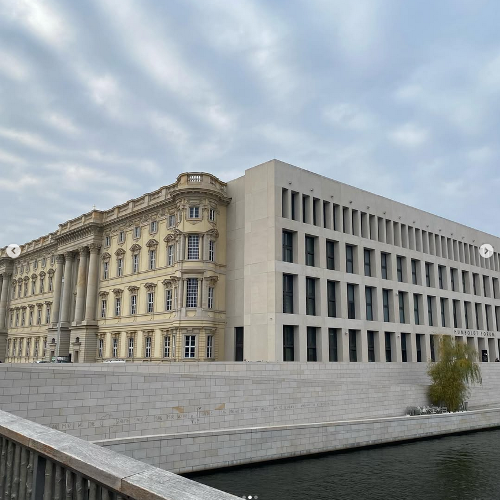
The Berlin Palace was rebuilt between 2013 and 2020. Today, it is the Humboldt
Forum—a venue for exhibitions, culture, science, and exchange. On the outside, it looks
just as it did in the past, complete with a Baroque dome and magnificent façades. Inside, however, everything is modern: large,
open spaces; museums housing artifacts from around the globe; and venues for dialogue on history,
art, and global interconnections.
The new palace is not merely a monument to bygone eras, but a place where
the future is contemplated. It demonstrates that history is not over—it lives on,
being retold and reshaped anew. The Berlin Palace was once a seat of power; today, it is
a place of dialogue.
Image 1: Original work by author
Image 2: Original work by author
Image 3: By Jörg Blobelt – Original work, CC BY-SA 4.0,
https://commons.wikimedia.org/w/index.php?curid=69779178
Berlin Palace
from the audio walk Berlin Like You’ve Never Heard It Before – True Stories & Secrets

254:05 min Audio
8
Listen to the audio tour now - ideally in full screen view.
Or use the app for listening to the audio walk on site:


Other stops on this audio tour:
A Brief Excursion into Berlin's History (7:59 min) • St. Nicholas' Church / St. Nicholas' Quarter (2:49 min) • Newspaper District (4:28 min) • Checkpoint Charlie (1:55 min) • Former Gestapo Headquarters (2:57 min) • Former Tempelhof Airport (3:46 min) • 7 Wannsee Conference (4:45 min) • Walther Rathenau Memorial (2:34 min) • Olympic Stadium / 1936 Olympic Games (5:36 min) • Commune 1 (2:27 min) • Benno Ohnesorg / Student Movement (2:16 min) • Rolf Eden (1:54 min) • Café Kranzler (2:08 min) • Kurfürstendamm (3:03 min) • Zoo Palace (3:47 min) • Kaiser Wilhelm Memorial Church (2:22 min) • Karl Liebknecht and Rosa Luxemburg (3:28 min) • Schöneberg Town Hall (2:33 min) • Former Sportpalast / Sportpalast Speech (5:12 min) • Bendlerblock/Stauffenberg assassination attempt (4:47 min) • Kroll Opera House / Enabling Act (3:09 min) • Reichstag Building (4:14 min) • Reichstag Fire (4:28 min) • Brandenburg Gate (2:52 min) • People's Court (3:08 min) • Potsdamer Place (2:58 min) • Former "Führerbunker" (5:06 min) • "Tresor" (Safe) (1:43 min) • Popular Uprising in the GDR (2:11 min) • Reich Chancellery / Hitler's Seizure of Power (5:11 min) • "Die weiße Maus" (The White Mouse) (2:57 min) • Friedrichstraße Station / "Tränenpalast" (Palace of Tears) (3:46 min) • Humboldt University (1:56 min) • Red City Hall (2:30 min) • Alexanderplatz (2:30 min) • Otto Weidt's Workshop for the Blind / Anne Frank Center (2:05 min) • Hackesche Höfe (5:21 min) • Rosenthaler Platz (2:58 min) • St. Sophia's Church (3:03 min) • Sophie-Gips Courtyards (2:08 min) • Koppenplatz (3:16 min) • Clärchen's Dance Hall (3:54 min) • New Synagogue (2:19 min) • Berliner Ensemble (3:55 min) • Friedrichstadt-Palast (4:02 min) • Dorotheenstadt Cemetery (2:25 min) • Bloody May (2:18 min) • Humboldthain Flak Tower (5:17 min) • Chris Gueffroy and the Victims of the Wall (1:28 min) • Tunnel 57 / Egon Schultz (2:40 min) • AMIGA (1:37 min) • Bernauer Street (4:07 min) • Former Bornholmer Straße Border Crossing (3:26 min) • Friedrich-Ludwig-Jahn Sports Park (3:43 min) • Mauerpark (4:07 min) • Arkonaplatz (3:03 min) • Zion Church (3:44 min) • Prenzlauer Berg Fire Station (3:18 min) • Hirschhof (2:41 min) • Freya Klier (2:28 min) • Prater (2:28 min) • Oderberger Straße Municipal Baths (3:36 min) • Oderberger Street 2 (1:58 min) • Currywurst (2:16 min) • Konnopke's Snack Bar (2:43 min) • Gethsemane Church (2:09 min) • Museum in the Kulturbrauerei (1:06 min) • Kulturbrauerei (3:24 min) • Frannz-Club (2:31 min) • Husemann Street (1:58 min) • Jews' Passage (3:32 min) • Prenzlauer Berg Water Tower (2:37 min) • Rosa Luxemburg Square (4:34 min) • Mont Klamott (1:43 min) • Samaritan Church (2:23 min) • Former Stasi Headquarters / Stasi Museum (2:48 min) • Berlin-Karlshorst Museum / Unconditional Surrender (2:54 min) • East Side Gallery (2:59 min) • House Squatting in the 1980s (2:34 min)