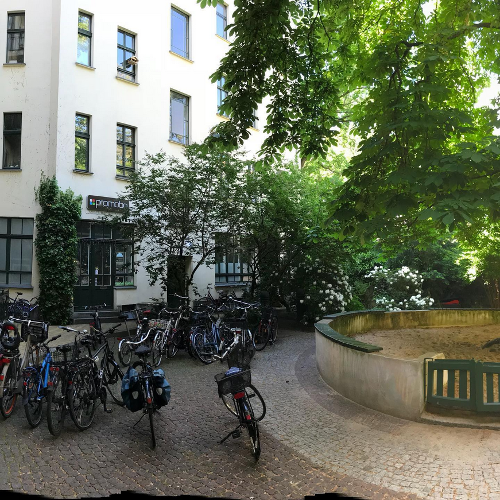
Right in the heart of Berlin-Mitte—just a few steps away from the hustle and bustle of the S-Bahn at Hackescher Markt—a gate opens to reveal a truly unique ensemble of courtyards: the Hackesche Höfe. Eight in number, all interconnected, they are brimming with art, history, and life.
Today, they are a popular destination for both Berliners and tourists. Yet, anyone strolling through these courtyards is simultaneously walking through over a century of history—a history marked by eras of splendor, expulsion, decay, and rebirth.
Their origins date back to the 18th century. At that time, the area consisted of marshland and fields—lying far beyond Berlin’s city gates. However, around 1750, ambitious construction plans were set in motion. The Prussian General Hans Christoph von Hacke commissioned the draining and development of the site.
Soon, the area became known as the Scheunenviertel (Barn Quarter)—so named because stables and barns originally stood there. It evolved into a dense, bustling district filled with small workshops, warehouses, and residential apartments—an area shaped in particular by Jewish and French immigrants. Hackescher Markt—named after General Hacke—became the vibrant heart of the district.
The Hackesche Höfe truly came into their own in 1906. Architect Kurt Berndt devised a concept that was revolutionary for its time: a blend of residential living, workspaces, and culture—all integrated into a single, expansive courtyard system that was both elegantly structured and functionally designed.
The first courtyard—situated directly on Rosenthaler Straße—served as the complex’s showpiece, adorned with intricate Art Nouveau tiles designed by the artist August Endell. The subsequent courtyards located behind it were dedicated to artisan workshops, offices, and residential apartments.
From the very outset, culture played a pivotal role: the complex featured a cinema, a theater, a cabaret, and literary clubs such as the “Neuer Club”—a gathering place for young authors and intellectuals. Jewish institutions also found a home here. In the 1920s, the function of the complex shifted: the department store chain DeFaKa
took over large sections of the courtyards for administrative and storage purposes. The cultural
luster faded—yet the architecture remained.
With the National Socialists’ rise to power, much was destroyed here as well. The
Jewish owner, Jakob Michael, was dispossessed and fled to the USA. The buildings
largely survived the war, but the history of the courtyards had taken a different turn.
After the war, the courtyards found themselves situated in East Berlin. They became
state property—yet were never properly maintained. The once-magnificent facades turned
gray and began to crumble.
It was not until 1977 that they were granted heritage protection—yet this proved
insufficient to truly save them. Many Berliners knew them only as dark passageways,
scarcely recognizing them for what they once had been.
Everything changed only after the fall of the Berlin Wall. Dedicated Berliners founded an
association and championed the cause of saving the courtyards. In 1993, renovation work
began—executed with meticulous attention to detail and immense effort. Over 80 million
Deutsche Marks were invested to restore and modernize the courtyards—and to revive
their original vision: living, working, and culture—all in one place.
Today, the Hackesche Höfe stand as a symbol of the new Berlin: creative, open, and
historically conscious. The complex features over 100 apartments, around 40 shops,
cafés, and galleries, the renowned Chamäleon Varieté—and a cinema, located precisely
where the “Imperial” once drew crowds in days gone by.
And still, that unique blend of past and present lingers here—whether one walks
through the first courtyard and gazes upon the Art Nouveau facade, or discovers a small
theater tucked away in the innermost courtyard.
The Hackesche Höfe are not a museum. They are alive. And yet, they evoke everything
that defines Berlin: ingenuity, ascent, ruptures, transformation.
Those who walk here stroll through history you can touch—right in the heart of the
capital.
Second image:
By Mark Ahsmann – Own work, CC BY-SA 3.0,
https://commons.wikimedia.org/w/index.php?curid=25644099
Third image:
Façade facing Hackescher Markt (1908), By unknown author –
http://filmtheater.square7.ch/wiki/index.php?
title=Datei:Mitte_Hackesche_H%C3%B6fe_1908.jpg, Public Domain,
https://commons.wikimedia.org/w/index.php?curid=48288107
Hackesche Höfe
from the audio walk Berlin Like You’ve Never Heard It Before – True Stories & Secrets

254:05 min Audio
8
Listen to the audio tour now - ideally in full screen view.
Or use the app for listening to the audio walk on site:


Other stops on this audio tour:
A Brief Excursion into Berlin's History (7:59 min) • St. Nicholas' Church / St. Nicholas' Quarter (2:49 min) • Newspaper District (4:28 min) • Checkpoint Charlie (1:55 min) • Former Gestapo Headquarters (2:57 min) • Former Tempelhof Airport (3:46 min) • 7 Wannsee Conference (4:45 min) • Walther Rathenau Memorial (2:34 min) • Olympic Stadium / 1936 Olympic Games (5:36 min) • Commune 1 (2:27 min) • Benno Ohnesorg / Student Movement (2:16 min) • Rolf Eden (1:54 min) • Café Kranzler (2:08 min) • Kurfürstendamm (3:03 min) • Zoo Palace (3:47 min) • Kaiser Wilhelm Memorial Church (2:22 min) • Karl Liebknecht and Rosa Luxemburg (3:28 min) • Schöneberg Town Hall (2:33 min) • Former Sportpalast / Sportpalast Speech (5:12 min) • Bendlerblock/Stauffenberg assassination attempt (4:47 min) • Kroll Opera House / Enabling Act (3:09 min) • Reichstag Building (4:14 min) • Reichstag Fire (4:28 min) • Brandenburg Gate (2:52 min) • People's Court (3:08 min) • Potsdamer Place (2:58 min) • Former "Führerbunker" (5:06 min) • "Tresor" (Safe) (1:43 min) • Popular Uprising in the GDR (2:11 min) • Reich Chancellery / Hitler's Seizure of Power (5:11 min) • "Die weiße Maus" (The White Mouse) (2:57 min) • Friedrichstraße Station / "Tränenpalast" (Palace of Tears) (3:46 min) • Humboldt University (1:56 min) • Berlin Palace (5:04 min) • Red City Hall (2:30 min) • Alexanderplatz (2:30 min) • Otto Weidt's Workshop for the Blind / Anne Frank Center (2:05 min) • Rosenthaler Platz (2:58 min) • St. Sophia's Church (3:03 min) • Sophie-Gips Courtyards (2:08 min) • Koppenplatz (3:16 min) • Clärchen's Dance Hall (3:54 min) • New Synagogue (2:19 min) • Berliner Ensemble (3:55 min) • Friedrichstadt-Palast (4:02 min) • Dorotheenstadt Cemetery (2:25 min) • Bloody May (2:18 min) • Humboldthain Flak Tower (5:17 min) • Chris Gueffroy and the Victims of the Wall (1:28 min) • Tunnel 57 / Egon Schultz (2:40 min) • AMIGA (1:37 min) • Bernauer Street (4:07 min) • Former Bornholmer Straße Border Crossing (3:26 min) • Friedrich-Ludwig-Jahn Sports Park (3:43 min) • Mauerpark (4:07 min) • Arkonaplatz (3:03 min) • Zion Church (3:44 min) • Prenzlauer Berg Fire Station (3:18 min) • Hirschhof (2:41 min) • Freya Klier (2:28 min) • Prater (2:28 min) • Oderberger Straße Municipal Baths (3:36 min) • Oderberger Street 2 (1:58 min) • Currywurst (2:16 min) • Konnopke's Snack Bar (2:43 min) • Gethsemane Church (2:09 min) • Museum in the Kulturbrauerei (1:06 min) • Kulturbrauerei (3:24 min) • Frannz-Club (2:31 min) • Husemann Street (1:58 min) • Jews' Passage (3:32 min) • Prenzlauer Berg Water Tower (2:37 min) • Rosa Luxemburg Square (4:34 min) • Mont Klamott (1:43 min) • Samaritan Church (2:23 min) • Former Stasi Headquarters / Stasi Museum (2:48 min) • Berlin-Karlshorst Museum / Unconditional Surrender (2:54 min) • East Side Gallery (2:59 min) • House Squatting in the 1980s (2:34 min)