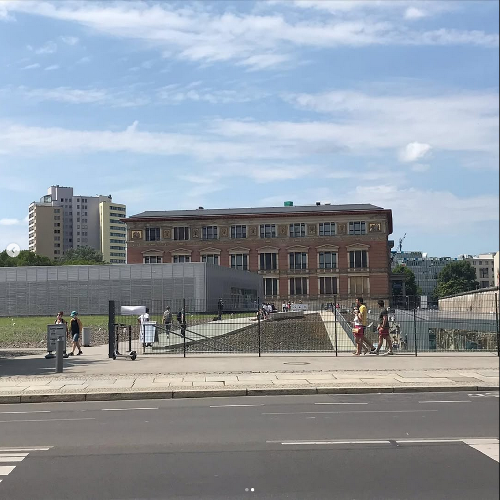
“You are standing here at a place where history was written in its darkest form.”
Where you stand today, a magnificent school building once stood. Built in the late 19th century as the Prussian School of Applied Arts, it was a place filled with creativity and learning. Young artists worked in its bright studios; the air was scented with fresh paint and wood shavings. Yet, this place was soon to lose its true identity.
In 1933—just weeks after the National Socialists seized power—the newly established Secret State Police, the Gestapo, moved in. Under Hermann Göring, renovations began. The spacious classrooms were converted into offices and interrogation rooms. In the basement, a prison was constructed—small, dark cells where political opponents were confined, interrogated, and often tortured.
The complex soon expanded. Next door, in the Hotel Prinz Albrecht, the SS leadership established its headquarters. The neighboring Prinz Albrecht Palace became the seat of the Reich Security Main Office. Together, these buildings formed the very heart of National Socialist terror. From this location, arrests, deportations, and murders were planned—not only in Berlin but throughout occupied Europe.
During the Second World War, Allied bombs struck this site as well. By 1945, the building lay in ruins. After the war, the rubble was cleared away. For decades, the grounds remained a vacant wasteland—situated directly alongside the Berlin Wall, overlooked and overgrown.
It was not until the 1980s that efforts to remember this history began. During excavations, the walls of the old basement were rediscovered. Today, you can still see the remains of the
cells where people were once imprisoned.
You are now standing in the very center of the “Topography of Terror” site. Here, a large open-air exhibition and a permanent indoor exhibition tell the story of this site and of the institutions that organized terror and crimes from this very location. Photographs, documents, and eyewitness accounts clearly demonstrate what took place here—and the consequences it had for millions of people.
What once began as a school became a center of terror—and is today a place of learning and remembrance. The “Topography of Terror” aims not only to commemorate but also to warn: to ensure that history does not repeat itself.
Image 1: Original work
Image 2: By Bundesarchiv, Image 183-R97512 / Author unknown / CC-BY-SA 3.0, CC BY-SA 3.0 de, https://commons.wikimedia.org/w/index.php?curid=5368800
Image 3: By Bundesarchiv, Image 183-R96954 / CC-BY-SA 3.0, CC BY-SA 3.0 de, https://commons.wikimedia.org/w/index.php?curid=5368794