Welcome to Arkonaplatz—a place where Berlin’s history comes alive, and which, in my opinion, is the most beautiful square in the city. Here, every bench, every tree, and every building tells stories of workers, war, GDR showcase projects, and even the birth of a football club. Immerse yourself in 150 years of vibrant Berlin history—right in the heart of the city, yet tucked away almost like a hidden gem.
The square received its name in 1875, named after Cape Arkona on the island of Rügen. Even back then, it was lined with residential buildings constructed primarily for the working class. Starting in 1881, the square served as a marketplace, and in 1918, a playground was added—becoming a popular gathering spot for both children and the neighborhood community.
Imagine yourself sitting on a bench at Arkonaplatz—just as two pairs of brothers did a very long time ago. It is 1892, and Berlin is brimming with energy and ideas. The young men are talking about football—a sport that is just beginning to gain traction in Germany. From this conversation, the idea for a club is born: Hertha 92, the predecessor to today’s Hertha BSC. Perhaps, as you sit here today, you are occupying the very same bench where Berlin’s football history began.
During World War II, roughly a quarter of the surrounding buildings were destroyed. After the war, the square lay vacant for a long time before the GDR launched an ambitious reconstruction project in the 1970s and 80s. The aim was to demonstrate how historic urban districts could be modernized. The result was a neighborhood featuring buildings with new facades, green spaces, and playgrounds—a true showcase district of the GDR era.
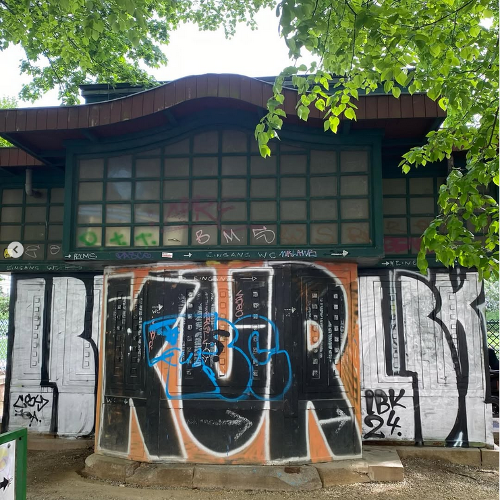
Since 1985, a weekly market has been held here regularly. On Fridays, you can purchase fresh fruit, vegetables, and delicious treats. On Sundays, the flea market draws the crowds—and that is when the old public restroom facility comes into use as well; it is a small historical treasure that, in truth, would be worthy of heritage protection.
Where poor working-class families once lived, young families and people with comfortable incomes reside today. Nevertheless, Arkonaplatz has retained its charm: green, quiet, and slightly off the beaten tourist path—a little insider tip steeped in history.
Image 1: Decommissioned public restroom facility, original work
Image 2: Original work
Image 3: Original work
Image 4: Original work
Image 5: Original work
Image 6: By Bundesarchiv, Image 183-1984-0509-011 / Junge, Peter Heinz / CC-BY-SA 3.0,
CC BY-SA 3.0 de, https://commons.wikimedia.org/w/index.php?curid=5422995
Image 7: By Bundesarchiv, Image 183-1987-0629-303 / Grimm, Peer / CC-BY-SA 3.0, CC
BY-SA 3.0 de, https://commons.wikimedia.org/w/index.php?curid=5423918
Arkonaplatz
from the audio walk Berlin Like You’ve Never Heard It Before – True Stories & Secrets

254:05 min Audio
8
Listen to the audio tour now - ideally in full screen view.
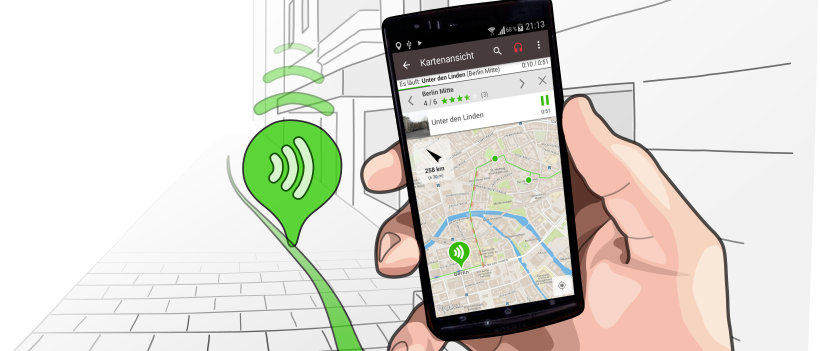
Or use the app for listening to the audio walk on site:


Other stops on this audio tour:
A Brief Excursion into Berlin's History (7:59 min) • St. Nicholas' Church / St. Nicholas' Quarter (2:49 min) • Newspaper District (4:28 min) • Checkpoint Charlie (1:55 min) • Former Gestapo Headquarters (2:57 min) • Former Tempelhof Airport (3:46 min) • 7 Wannsee Conference (4:45 min) • Walther Rathenau Memorial (2:34 min) • Olympic Stadium / 1936 Olympic Games (5:36 min) • Commune 1 (2:27 min) • Benno Ohnesorg / Student Movement (2:16 min) • Rolf Eden (1:54 min) • Café Kranzler (2:08 min) • Kurfürstendamm (3:03 min) • Zoo Palace (3:47 min) • Kaiser Wilhelm Memorial Church (2:22 min) • Karl Liebknecht and Rosa Luxemburg (3:28 min) • Schöneberg Town Hall (2:33 min) • Former Sportpalast / Sportpalast Speech (5:12 min) • Bendlerblock/Stauffenberg assassination attempt (4:47 min) • Kroll Opera House / Enabling Act (3:09 min) • Reichstag Building (4:14 min) • Reichstag Fire (4:28 min) • Brandenburg Gate (2:52 min) • People's Court (3:08 min) • Potsdamer Place (2:58 min) • Former "Führerbunker" (5:06 min) • "Tresor" (Safe) (1:43 min) • Popular Uprising in the GDR (2:11 min) • Reich Chancellery / Hitler's Seizure of Power (5:11 min) • "Die weiße Maus" (The White Mouse) (2:57 min) • Friedrichstraße Station / "Tränenpalast" (Palace of Tears) (3:46 min) • Humboldt University (1:56 min) • Berlin Palace (5:04 min) • Red City Hall (2:30 min) • Alexanderplatz (2:30 min) • Otto Weidt's Workshop for the Blind / Anne Frank Center (2:05 min) • Hackesche Höfe (5:21 min) • Rosenthaler Platz (2:58 min) • St. Sophia's Church (3:03 min) • Sophie-Gips Courtyards (2:08 min) • Koppenplatz (3:16 min) • Clärchen's Dance Hall (3:54 min) • New Synagogue (2:19 min) • Berliner Ensemble (3:55 min) • Friedrichstadt-Palast (4:02 min) • Dorotheenstadt Cemetery (2:25 min) • Bloody May (2:18 min) • Humboldthain Flak Tower (5:17 min) • Chris Gueffroy and the Victims of the Wall (1:28 min) • Tunnel 57 / Egon Schultz (2:40 min) • AMIGA (1:37 min) • Bernauer Street (4:07 min) • Former Bornholmer Straße Border Crossing (3:26 min) • Friedrich-Ludwig-Jahn Sports Park (3:43 min) • Mauerpark (4:07 min) • Zion Church (3:44 min) • Prenzlauer Berg Fire Station (3:18 min) • Hirschhof (2:41 min) • Freya Klier (2:28 min) • Prater (2:28 min) • Oderberger Straße Municipal Baths (3:36 min) • Oderberger Street 2 (1:58 min) • Currywurst (2:16 min) • Konnopke's Snack Bar (2:43 min) • Gethsemane Church (2:09 min) • Museum in the Kulturbrauerei (1:06 min) • Kulturbrauerei (3:24 min) • Frannz-Club (2:31 min) • Husemann Street (1:58 min) • Jews' Passage (3:32 min) • Prenzlauer Berg Water Tower (2:37 min) • Rosa Luxemburg Square (4:34 min) • Mont Klamott (1:43 min) • Samaritan Church (2:23 min) • Former Stasi Headquarters / Stasi Museum (2:48 min) • Berlin-Karlshorst Museum / Unconditional Surrender (2:54 min) • East Side Gallery (2:59 min) • House Squatting in the 1980s (2:34 min)