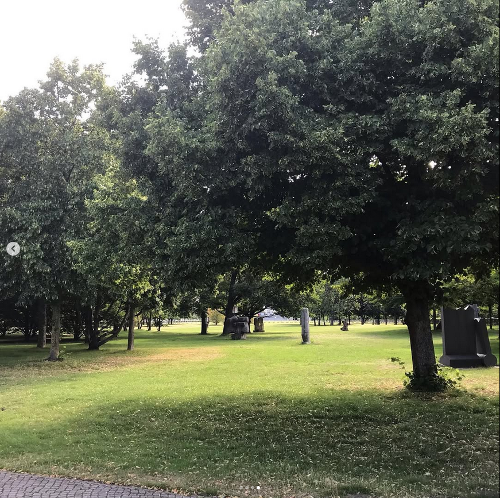
Here, where today only a memorial stone stands, a large, elegant building once stood. It was called the Krolloper. It was once a place filled with music, theater, and dance. It was built in 1844. Initially, it served as a grand ballroom—a venue where people could celebrate and attend concerts. Later, it was transformed into an opera house.
In the 1920s, when Germany was a democracy, modern operas were performed here. The music was new, bold, and exciting. Many people loved it—though some found it too strange or simply “bad.” The National Socialists—Hitler’s party, in particular—detested this modern art.
Then came the year 1933—a turning point in German history. Hitler had just risen to power. On February 27, 1933, the Reichstag—the German parliament—went up in flames. The Nazis blamed the Communists for the fire; consequently, many Communists were arrested. The Reichstag had been severely damaged by the blaze. As a result, the Krolloper—located directly across the street—was selected to serve as the parliament’s new venue.
On March 23, 1933, a momentous—and highly perilous—event took place there: The parliament voted on a new piece of legislation. It was known as the Enabling Act. In essence, this meant that Hitler would now be empowered to enact laws on his own, without consulting the parliament. Through this act, Hitler acquired nearly unlimited power.
The vote took place in a hall draped with swastika flags. Outside, members of the SA and SS stood guard. Many members of parliament felt intimidated. The Communist deputies were not present at all—they had already been arrested or had fled the country.
Only the SPD—the Social Democratic Party—voted against the bill. Their representative, Otto Wels, delivered a courageous speech. He declared:
“They may take our freedom and our lives, but they cannot take our honor.”
Democracy had come to an end. Political parties were banned, newspapers censored, and people arrested. Germany became a dictatorship.
The Kroll Opera House—formerly a venue for music—thus became a symbol of the end of freedom. The building was destroyed during the war. It was demolished in 1951. Today, only a single stone remains to remind us that an opera house once stood here—and that it was right here that democracy in Germany came to an end.
Image 1: Original work
Image 2: Public domain, https://commons.wikimedia.org/w/index.php?curid=312217
Image 3: By Bundesarchiv, Image 183-J1209-0501-001 / CC-BY-SA 3.0, CC BY-SA 3.0 de, https://commons.wikimedia.org/w/index.php?curid=5364722
Image 4: By Bundesarchiv, Image 102-09067 / CC-BY-SA 3.0, CC BY-SA 3.0 de, https://commons.wikimedia.org/w/index.php?curid=5414435
Image 5: By Bundesarchiv, Image 102-14439 / CC-BY-SA 3.0, CC BY-SA 3.0 de, https://commons.wikimedia.org/w/index.php?curid=5415524