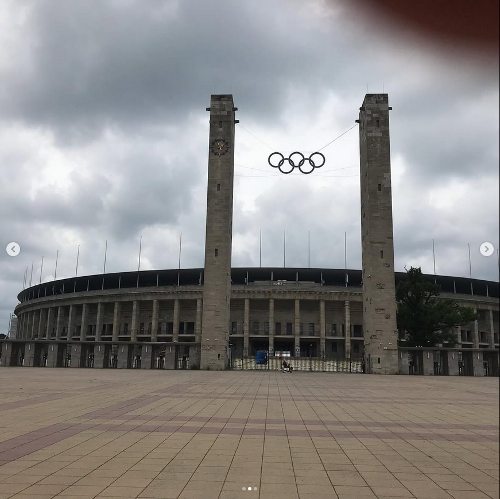
Imagine standing here in Berlin’s Olympic Stadium—not today, but in the summer of 1936. Tens of thousands of people sit all around you. Music plays, swastika flags wave, drums beat. The Olympic Games are about to begin—with a grand spectacle intended for the whole world to see. The stadium is brand-new, built of gray stone—vast and austere. Everything appears orderly, powerful, and impressive. This was exactly the intention. The National Socialists, who held power in Germany at the time, wanted to use these Games to demonstrate just how strong and modern their country was. Yet that was merely the façade.
Behind the scenes, the reality was starkly different: people were ostracized, persecuted, or even killed—simply because they were Jewish, or because they did not fit the image Hitler held of a “true German.” This reality was palpable in the world of sports as well: many Jewish athletes were barred from participating in the Games. One of them was Gretel Bergmann. She was one of Germany’s top high jumpers, yet she was dropped from the team just before the Games began—simply because she was Jewish. Another athlete, Helene Mayer, was permitted to compete—because she was expected to win a medal—but even that decision was driven by propaganda motives.
The opening ceremony was a colossal spectacle. For the very first time, the Olympic flame was carried from Greece to Germany in a torch relay. The Nazis had orchestrated every single step. And seated high atop the VIP tribune was Adolf Hitler—surrounded by his officials. He wanted to show the world that Germany was a force to be reckoned with once again; that everything was peaceful; that order prevailed. The propaganda worked—many visitors from abroad were deeply impressed.
But then, something happened that did not fit into Hitler’s plan: A young Black man from the United States—Jesse Owens—stepped onto the world stage. He was fast. Incredibly fast. He won four gold medals—in the 100-meter dash, the long jump, the 200-meter dash, and the 4×100-meter relay. And he did so in a country that claimed Black people were inferior. Owens proved the opposite—with his legs, with his courage, and with a smile on his face.
How did Hitler react? Initially, he had shaken the hands of the victors. But when Owens won, he vanished from the stadium. Officially, the explanation was that he wished to “remain neutral.” In truth, he refused to acknowledge that a Black athlete could captivate the crowd—and defeat the German competitors.
Yet there were also signs of humanity: The German long jumper Luz Long—a favorite himself—offered Owens tips during the competition and graciously congratulated him on his victory. Their friendship remains, to this day, a symbol of true sporting greatness.
And then there was someone standing behind the camera: Leni Riefenstahl. She was the most renowned filmmaker of the Third Reich. She had already filmed the Nazi Party Congress in Nuremberg; now, she was tasked with staging the Olympic Games. She employed cutting-edge technology, rigging cameras to cables that soared through the air, and filming from underwater and in slow motion. Her film Olympia is still regarded today as one of the finest sports documentaries of all time.
However, it is not merely a film about sports. Riefenstahl portrayed the athletes’ bodies as if they were Greek gods—strong, beautiful, and “pure.” This aligned perfectly with Nazi ideology. To this day, the debate continues: Was she simply a brilliant artist, or an enabler of propaganda? One thing is certain: Her images were powerful. And they played a part in broadcasting the lie of a “peaceful Germany” to the entire world.
After the Second World War, Germany lay in ruins—and the Olympic Stadium, too, had suffered damage. British troops initially used it as a sports ground. Later, it became the home of Hertha BSC. In the 2000s, the stadium was renovated and modernized. Since the 2006 World Cup, it has served as a venue for major matches, concerts, and festivals. Today, the stadium is modern, open, and vibrant—a place where people from all over the world come together.
And yet: As you stand here, you sense that this place is more than just a football stadium. It tells a story. Of exclusion and courage. Of lies and truth. Of heroes—and of how vital it is to look closely.
-
Bild: eigenes Werk
-
Bild: Von Bundesarchiv, B 145 Bild-P017073 / Frankl, A. / CC-BY-SA 3.0, CC BY-SA 3.0 de, https://commons.wikimedia.org/w/index.php?curid=5474552
-
Bild: Von Bundesarchiv, Bild 183-G00372 / CC-BY-SA 3.0, CC BY-SA 3.0 de, https://commons.wikimedia.org/w/index.php?curid=5363153
-
Bild: Von Bundesarchiv, Bild 183-R96374 / CC-BY-SA 3.0, CC BY-SA 3.0 de, https://commons.wikimedia.org/w/index.php?curid=5368787
-
Bild: Von Bundesarchiv, Bild 146-1968-036-06 / CC-BY-SA 3.0, CC BY-SA 3.0 de, https://commons.wikimedia.org/w/index.php?curid=5482500