Now we travel on—into the eventful history of Clärchens Ballhaus.
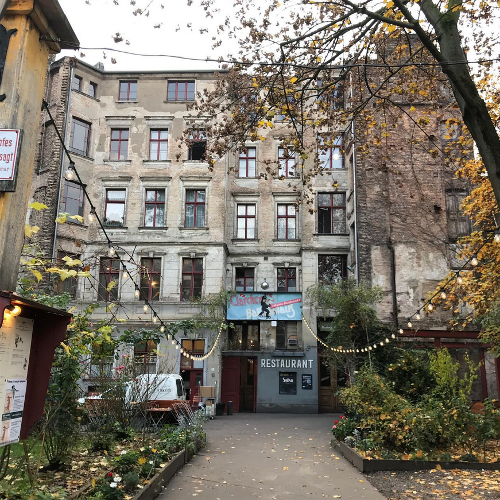
Opened in 1913 by Fritz and Clara Bühler—specifically on September 13, 1913—in the rear building at Auguststraße 24/25. Early on, Berliners affectionately dubbed it “Clärchens Ballhaus.”
“After her husband’s death in 1929, Clara continued to run the establishment on her own—and continued to do so under her real name, Clara Habermann, after remarrying in 1932. By this time, the Ballhaus had evolved into a true Berlin institution.
During the Nazi era, in 1944, the National Socialists banned all forms of public entertainment; consequently, the Ballhaus was forced to close. Shortly thereafter, the front building was destroyed, and dancing activities came to a halt.
But the story did not end there: As early as July 1945—just two months after the end of the war—Clärchens reopened. Operating initially out of the rear building, the dancing resumed.
Throughout the GDR era, Clärchens Ballhaus remained a privately owned business—unlike most other venues. It attracted people from both East and West in equal measure. Despite surveillance by the Stasi during the 1970s, up to 400 guests would gather here to celebrate every evening.
In 1965, the ruins of the front building were demolished; the site has remained vacant to this day.
In 1967, Clara’s stepdaughter, Elfriede Wolff, took over management of the venue; she was later succeeded by her son, Stefan Wolff, who ran it until 2004.
Following German reunification, the building initially remained closed. However, in 2005, Christian Schulz and David Regehr took over operations, breathing new life into Clärchens Ballhaus—modern in spirit, yet true to its historic style. For the first time in decades, the Spiegelsaal (Hall of Mirrors) was once again made accessible for use.
The Spiegelsaal in particular—with its stucco ceiling, large wall-mounted mirrors, and private boxes—had stood cluttered with stored items for decades; it has now been lovingly restored.
In 2018, however, the building was sold. The new owner is the Berlin-based photographer and investor Yoram Roth. He has announced that the venue’s operations will be preserved, and that the building will be protected and renovated to meet contemporary standards.” In July 2020, Clärchens Ballhaus reopened—featuring the restaurant “Luna D’Oro”
in the lower hall, named after the legendary dancer Lisbeth Dorowski, alias “Luna
d’Oro.” Dance events continue to take place in the Hall of Mirrors.
Today, Clärchens Ballhaus is more than just dancing—it is a living piece of Berlin
culture. Two world wars, five political systems—and yet, the dance floor remains.
In the Hall of Mirrors, one can sense the echoes of decades past—and it continues to
invite visitors to dance, music, and social gatherings.
This is exactly what Clara envisioned—and it lives on to this very day.
Clärchen's Dance Hall
from the audio walk Berlin Like You’ve Never Heard It Before – True Stories & Secrets

254:05 min Audio
8
Listen to the audio tour now - ideally in full screen view.
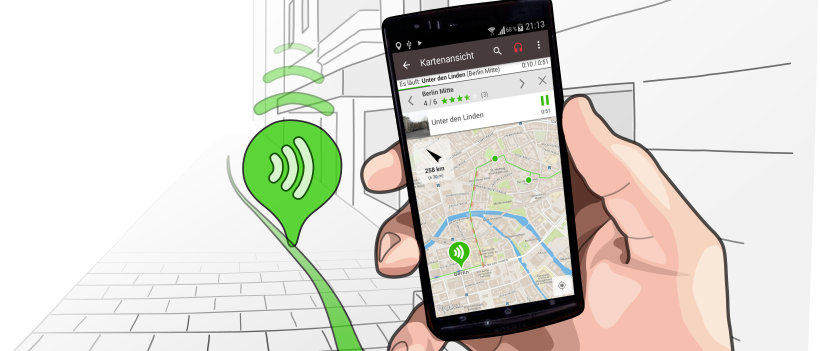
Or use the app for listening to the audio walk on site:


Other stops on this audio tour:
A Brief Excursion into Berlin's History (7:59 min) • St. Nicholas' Church / St. Nicholas' Quarter (2:49 min) • Newspaper District (4:28 min) • Checkpoint Charlie (1:55 min) • Former Gestapo Headquarters (2:57 min) • Former Tempelhof Airport (3:46 min) • 7 Wannsee Conference (4:45 min) • Walther Rathenau Memorial (2:34 min) • Olympic Stadium / 1936 Olympic Games (5:36 min) • Commune 1 (2:27 min) • Benno Ohnesorg / Student Movement (2:16 min) • Rolf Eden (1:54 min) • Café Kranzler (2:08 min) • Kurfürstendamm (3:03 min) • Zoo Palace (3:47 min) • Kaiser Wilhelm Memorial Church (2:22 min) • Karl Liebknecht and Rosa Luxemburg (3:28 min) • Schöneberg Town Hall (2:33 min) • Former Sportpalast / Sportpalast Speech (5:12 min) • Bendlerblock/Stauffenberg assassination attempt (4:47 min) • Kroll Opera House / Enabling Act (3:09 min) • Reichstag Building (4:14 min) • Reichstag Fire (4:28 min) • Brandenburg Gate (2:52 min) • People's Court (3:08 min) • Potsdamer Place (2:58 min) • Former "Führerbunker" (5:06 min) • "Tresor" (Safe) (1:43 min) • Popular Uprising in the GDR (2:11 min) • Reich Chancellery / Hitler's Seizure of Power (5:11 min) • "Die weiße Maus" (The White Mouse) (2:57 min) • Friedrichstraße Station / "Tränenpalast" (Palace of Tears) (3:46 min) • Humboldt University (1:56 min) • Berlin Palace (5:04 min) • Red City Hall (2:30 min) • Alexanderplatz (2:30 min) • Otto Weidt's Workshop for the Blind / Anne Frank Center (2:05 min) • Hackesche Höfe (5:21 min) • Rosenthaler Platz (2:58 min) • St. Sophia's Church (3:03 min) • Sophie-Gips Courtyards (2:08 min) • Koppenplatz (3:16 min) • New Synagogue (2:19 min) • Berliner Ensemble (3:55 min) • Friedrichstadt-Palast (4:02 min) • Dorotheenstadt Cemetery (2:25 min) • Bloody May (2:18 min) • Humboldthain Flak Tower (5:17 min) • Chris Gueffroy and the Victims of the Wall (1:28 min) • Tunnel 57 / Egon Schultz (2:40 min) • AMIGA (1:37 min) • Bernauer Street (4:07 min) • Former Bornholmer Straße Border Crossing (3:26 min) • Friedrich-Ludwig-Jahn Sports Park (3:43 min) • Mauerpark (4:07 min) • Arkonaplatz (3:03 min) • Zion Church (3:44 min) • Prenzlauer Berg Fire Station (3:18 min) • Hirschhof (2:41 min) • Freya Klier (2:28 min) • Prater (2:28 min) • Oderberger Straße Municipal Baths (3:36 min) • Oderberger Street 2 (1:58 min) • Currywurst (2:16 min) • Konnopke's Snack Bar (2:43 min) • Gethsemane Church (2:09 min) • Museum in the Kulturbrauerei (1:06 min) • Kulturbrauerei (3:24 min) • Frannz-Club (2:31 min) • Husemann Street (1:58 min) • Jews' Passage (3:32 min) • Prenzlauer Berg Water Tower (2:37 min) • Rosa Luxemburg Square (4:34 min) • Mont Klamott (1:43 min) • Samaritan Church (2:23 min) • Former Stasi Headquarters / Stasi Museum (2:48 min) • Berlin-Karlshorst Museum / Unconditional Surrender (2:54 min) • East Side Gallery (2:59 min) • House Squatting in the 1980s (2:34 min)