You are standing right in the heart of Berlin. All around you are cobblestones, narrow lanes, and ancient walls. This is where it all began—nearly 800 years ago.
Around 1230, a small market sprang up at this very spot on the banks of the Spree River. A wooden bridge—the Mühlendamm—connected the original settlement of Berlin (where we stand right now) with Cölln on the western side of the Spree. At the center of it all stood St. Nicholas’ Church.
Initially, it was a simple basilica built of fieldstone. Starting in 1264, it was rebuilt as a Gothic hall church. Even in the Middle Ages, its tower served as a symbol: This is where the heart of the city beats.
The church was a central meeting place. People came here to pray, to trade, and to negotiate. All around, artisans, boatmen, and merchants made their homes. In the narrow lanes, the air was filled with the scent of bread from the bakeries, of tanned leather, and of the resin from the shipyards.
Throughout the 15th and 16th centuries, the streets remained narrow and the houses were built in the half-timbered style. Wealthy merchants moved to other districts, yet St. Nicholas’ Church remained the focal point of community life.
In the 18th century, magnificent townhouses were added to the district—such as the Ephraim-Palais (built in 1766) and the Knoblauchhaus (built in 1759). Around 1877, the church acquired its two Neo-Gothic spires. During the 19th century, large department stores—such as the famous Nathan Israel—also sprang up nearby.
Then came the Second World War. Bombs devastated almost the entire district. The church was gutted by fire, leaving only its walls standing. For decades, it remained a ruin.
In the 1980s, the GDR decided to rebuild the Nikolaiviertel. In time for Berlin’s 750th anniversary celebrations in 1987, historical buildings were reconstructed and St. Nicholas’ Church was restored.
Today, St. Nicholas’ Church serves as both a museum and a concert venue. Amidst old and new walls, here in the Nikolaiviertel, you can walk through the centuries—and see where Berlin was born.
1st Image: Own work
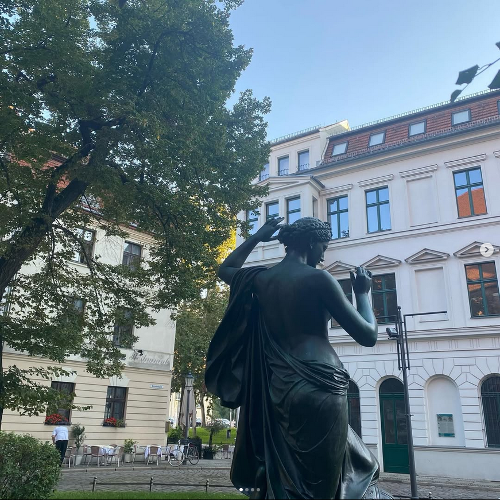
2nd Image: Own work
3rd Image: Own work
4th Image: Own work
5th Image: By Bundesarchiv, Image 183-09403-0002 / CC-BY-SA 3.0, CC BY-SA 3.0 de, https://commons.wikimedia.org/w/index.php?curid=5338982
6th Image: By F. Albert Schwartz – Staatliche Museen zu Berlin, Kunstbibliothek: D 148d gr./1166, Public Domain, https://commons.wikimedia.org/w/index.php?curid=4060617