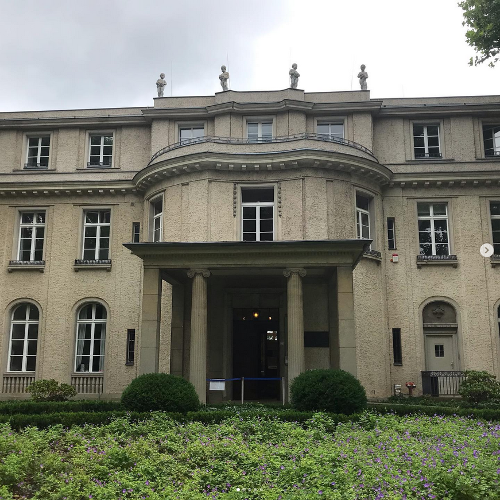
You are now standing in a quiet, almost idyllic spot. Lake Wannsee stretches out before you; the water
glitters in the sun. Birds are chirping, and boats are bobbing on the waves. It feels like a peaceful holiday retreat.
Yet it was right here—in this beautiful villa—that a conference took place on January 20, 1942, which had nothing to do with a holiday, but rather with a crime that cost millions of people their lives.
First, a brief look at the building’s history:
The villa on Lake Wannsee was built in 1914 as a summer residence for the industrialist Ernst Marlier. Later, it was acquired by another businessman, Friedrich Minoux, who eventually sold it to the SS Foundation. From 1941 onward, the SS used the house as a guest and conference center.
Thus, an elegant villa overlooking the lake was transformed into a seat of National Socialist power—and ultimately became the venue for the Wannsee Conference on January 20, 1942.
On that morning, fifteen men gathered here. They belonged to the highest echelons of the Nazi state: high-ranking SS officers, and officials from various ministries, the police, and the administration. They had been invited by Reinhard Heydrich. He was one of the most powerful men in the SS and was directly responsible for planning the Holocaust—that is, the systematic murder of European Jews.
Also seated at the table was Adolf Eichmann. He was the man who would later organize the deportations by train to the extermination camps. Other participants came from the Ministry of the Interior, the Ministry of Foreign Affairs, the Ministry of Justice, and the administration of the occupied territories—including Wilhelm Stuckart, a co-author of the Nuremberg Race Laws, and Josef Bühler, the representative of the so-called General Government in Poland, where many of the mass killings took place.
They all held different positions, but they shared a single goal: the so-called “Final Solution to the Jewish Question.” This signified nothing less than the plan to identify, deport, and murder every Jewish person in Europe.
Figures were cited at the conference: over 11 million Jews were to be targeted—from Germany, France, Poland, the Netherlands, and the Balkans, and even from countries like England or Spain, which were not under German control at the time. This demonstrates just how far-reaching this plan was intended to be.
The conference itself lasted only about 90 minutes. They ate, they smoked, and minutes were taken. And throughout it all, they spoke in cool, clinical language. There was talk of “special treatment”—a code word for murder. Of “evacuation”—which
meant deportation in freight trains to the East. Of “deployment for labor”—which often led to
certain death.
What makes this conference so profoundly disturbing is not merely what was decided,
but how it was decided. Quite calmly. Without major debate. No one protested. No one raised questions of conscience. They reached a consensus quickly. Everyone knew
what was meant—and what was at stake.
And then they left. Back to their offices, back to their families. Many of these men led bourgeois lives. They were educated, university-trained; some were lawyers or administrative experts. And yet, they were part of a program of murder unlike any the world had ever seen.
Today, this villa serves as a place of learning and remembrance. Here, one can see and grasp how language was transformed into deeds. How administrative files became instruments of murder. And how dangerous it is when people stop asking questions—and simply “do their duty.”
This place reminds us that the greatest crime of the 20th century did not begin in a dark back room—but rather on a sunny winter’s day, in a villa overlooking the Wannsee.
7 Wannsee Conference
from the audio walk Berlin Like You’ve Never Heard It Before – True Stories & Secrets

254:05 min Audio
8
Listen to the audio tour now - ideally in full screen view.
Or use the app for listening to the audio walk on site:


Other stops on this audio tour:
A Brief Excursion into Berlin's History (7:59 min) • St. Nicholas' Church / St. Nicholas' Quarter (2:49 min) • Newspaper District (4:28 min) • Checkpoint Charlie (1:55 min) • Former Gestapo Headquarters (2:57 min) • Former Tempelhof Airport (3:46 min) • Walther Rathenau Memorial (2:34 min) • Olympic Stadium / 1936 Olympic Games (5:36 min) • Commune 1 (2:27 min) • Benno Ohnesorg / Student Movement (2:16 min) • Rolf Eden (1:54 min) • Café Kranzler (2:08 min) • Kurfürstendamm (3:03 min) • Zoo Palace (3:47 min) • Kaiser Wilhelm Memorial Church (2:22 min) • Karl Liebknecht and Rosa Luxemburg (3:28 min) • Schöneberg Town Hall (2:33 min) • Former Sportpalast / Sportpalast Speech (5:12 min) • Bendlerblock/Stauffenberg assassination attempt (4:47 min) • Kroll Opera House / Enabling Act (3:09 min) • Reichstag Building (4:14 min) • Reichstag Fire (4:28 min) • Brandenburg Gate (2:52 min) • People's Court (3:08 min) • Potsdamer Place (2:58 min) • Former "Führerbunker" (5:06 min) • "Tresor" (Safe) (1:43 min) • Popular Uprising in the GDR (2:11 min) • Reich Chancellery / Hitler's Seizure of Power (5:11 min) • "Die weiße Maus" (The White Mouse) (2:57 min) • Friedrichstraße Station / "Tränenpalast" (Palace of Tears) (3:46 min) • Humboldt University (1:56 min) • Berlin Palace (5:04 min) • Red City Hall (2:30 min) • Alexanderplatz (2:30 min) • Otto Weidt's Workshop for the Blind / Anne Frank Center (2:05 min) • Hackesche Höfe (5:21 min) • Rosenthaler Platz (2:58 min) • St. Sophia's Church (3:03 min) • Sophie-Gips Courtyards (2:08 min) • Koppenplatz (3:16 min) • Clärchen's Dance Hall (3:54 min) • New Synagogue (2:19 min) • Berliner Ensemble (3:55 min) • Friedrichstadt-Palast (4:02 min) • Dorotheenstadt Cemetery (2:25 min) • Bloody May (2:18 min) • Humboldthain Flak Tower (5:17 min) • Chris Gueffroy and the Victims of the Wall (1:28 min) • Tunnel 57 / Egon Schultz (2:40 min) • AMIGA (1:37 min) • Bernauer Street (4:07 min) • Former Bornholmer Straße Border Crossing (3:26 min) • Friedrich-Ludwig-Jahn Sports Park (3:43 min) • Mauerpark (4:07 min) • Arkonaplatz (3:03 min) • Zion Church (3:44 min) • Prenzlauer Berg Fire Station (3:18 min) • Hirschhof (2:41 min) • Freya Klier (2:28 min) • Prater (2:28 min) • Oderberger Straße Municipal Baths (3:36 min) • Oderberger Street 2 (1:58 min) • Currywurst (2:16 min) • Konnopke's Snack Bar (2:43 min) • Gethsemane Church (2:09 min) • Museum in the Kulturbrauerei (1:06 min) • Kulturbrauerei (3:24 min) • Frannz-Club (2:31 min) • Husemann Street (1:58 min) • Jews' Passage (3:32 min) • Prenzlauer Berg Water Tower (2:37 min) • Rosa Luxemburg Square (4:34 min) • Mont Klamott (1:43 min) • Samaritan Church (2:23 min) • Former Stasi Headquarters / Stasi Museum (2:48 min) • Berlin-Karlshorst Museum / Unconditional Surrender (2:54 min) • East Side Gallery (2:59 min) • House Squatting in the 1980s (2:34 min)