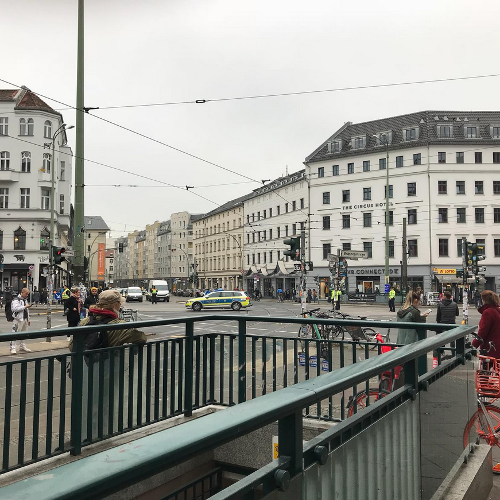
Five streets intersect here—creating a distinct “crossroads” vibe rather than the classic charm of a traditional public square.
Yet it is precisely here—at, on, or around Rosenthaler Platz—that the pulse of Berlin’s modern history beats strongest.
In earlier times—specifically from around 1705—the Rosenthaler Tor (Rosenthal Gate) stood here as part of the Customs Wall, serving as an entry point into the Spandauer Vorstadt district. From 1737 onwards, it was one of only two city gates through which Jewish people were officially permitted to enter Berlin; all others remained strictly off-limits. Directly adjacent to it, established in 1752 by Frederick II, lay the artisan colony “Neu-Voigtland”—in essence, Prussia’s early foray into social housing.
The gate itself vanished in 1868. In its place, the area officially received its current name in 1910: Rosenthaler Platz. From that moment on, it became a true hub of daily life in Berlin.
During the 1920s, the district was as vibrant as ever: a lively mix of laborers, artisans, and pubs—and right in the thick of it was Alfred Döblin’s character Franz Biberkopf from the novel Berlin Alexanderplatz, who frequently traveled through here by tram.
On the very spot where the “St. Oberholz” café stands today, one could—from 1890 until shortly after the end of the Second World War—enjoy excellent and, above all, remarkably affordable food and drink. Schrippen (bread rolls), pea soup, beer sausages, and, of course, delicious Berlin beer were immensely popular here—particularly among the city’s poorer residents.
Then, in 1930, came the Rosenthaler Platz U-Bahn station—designed by the renowned architect Alfred Grenander. Its famous orange uranium-glazed tiles remain a bold design statement to this very day.
From August 13, 1961—following the division of Berlin—the station became a “ghost station.” Trains traveling from West Berlin would pass straight through this stretch of East Berlin without stopping—a situation that persisted until December 22, 1989, shortly after the fall of the Berlin Wall. Today, life pulses here once again: cafés, start-ups, galleries.
Image credits:
Image 3:
By Gerd Danigel – Own work, CC BY-SA 4.0,
https://commons.wikimedia.org/w/index.php?curid=57172280
Image 4:
By Leopold Ludwig Müller (1768–1839) (attributed) – Staatliche Museen zu Berlin,
Kupferstichkabinett / Dietmar Katz, Public Domain,
https://commons.wikimedia.org/w/index.php?curid=152273914
Image 5:
By F. Albert Schwartz – Landesarchiv Berlin, Public Domain,
https://commons.wikimedia.org/w/index.php?curid=152755691
Image 6:
By F. Albert Schwartz – Berliner Landesarchiv, Public Domain,
https://commons.wikimedia.org/w/index.php?curid=152755143
Image 7:
By Max Missmann – Klünner, Hans-Werner: Berliner Plätze, Argon Berlin, 1992, p. 37,
Public Domain, https://commons.wikimedia.org/w/index.php?curid=144042303
Rosenthaler Platz
from the audio walk Berlin Like You’ve Never Heard It Before – True Stories & Secrets

254:05 min Audio
8
Listen to the audio tour now - ideally in full screen view.
Or use the app for listening to the audio walk on site:


Other stops on this audio tour:
A Brief Excursion into Berlin's History (7:59 min) • St. Nicholas' Church / St. Nicholas' Quarter (2:49 min) • Newspaper District (4:28 min) • Checkpoint Charlie (1:55 min) • Former Gestapo Headquarters (2:57 min) • Former Tempelhof Airport (3:46 min) • 7 Wannsee Conference (4:45 min) • Walther Rathenau Memorial (2:34 min) • Olympic Stadium / 1936 Olympic Games (5:36 min) • Commune 1 (2:27 min) • Benno Ohnesorg / Student Movement (2:16 min) • Rolf Eden (1:54 min) • Café Kranzler (2:08 min) • Kurfürstendamm (3:03 min) • Zoo Palace (3:47 min) • Kaiser Wilhelm Memorial Church (2:22 min) • Karl Liebknecht and Rosa Luxemburg (3:28 min) • Schöneberg Town Hall (2:33 min) • Former Sportpalast / Sportpalast Speech (5:12 min) • Bendlerblock/Stauffenberg assassination attempt (4:47 min) • Kroll Opera House / Enabling Act (3:09 min) • Reichstag Building (4:14 min) • Reichstag Fire (4:28 min) • Brandenburg Gate (2:52 min) • People's Court (3:08 min) • Potsdamer Place (2:58 min) • Former "Führerbunker" (5:06 min) • "Tresor" (Safe) (1:43 min) • Popular Uprising in the GDR (2:11 min) • Reich Chancellery / Hitler's Seizure of Power (5:11 min) • "Die weiße Maus" (The White Mouse) (2:57 min) • Friedrichstraße Station / "Tränenpalast" (Palace of Tears) (3:46 min) • Humboldt University (1:56 min) • Berlin Palace (5:04 min) • Red City Hall (2:30 min) • Alexanderplatz (2:30 min) • Otto Weidt's Workshop for the Blind / Anne Frank Center (2:05 min) • Hackesche Höfe (5:21 min) • St. Sophia's Church (3:03 min) • Sophie-Gips Courtyards (2:08 min) • Koppenplatz (3:16 min) • Clärchen's Dance Hall (3:54 min) • New Synagogue (2:19 min) • Berliner Ensemble (3:55 min) • Friedrichstadt-Palast (4:02 min) • Dorotheenstadt Cemetery (2:25 min) • Bloody May (2:18 min) • Humboldthain Flak Tower (5:17 min) • Chris Gueffroy and the Victims of the Wall (1:28 min) • Tunnel 57 / Egon Schultz (2:40 min) • AMIGA (1:37 min) • Bernauer Street (4:07 min) • Former Bornholmer Straße Border Crossing (3:26 min) • Friedrich-Ludwig-Jahn Sports Park (3:43 min) • Mauerpark (4:07 min) • Arkonaplatz (3:03 min) • Zion Church (3:44 min) • Prenzlauer Berg Fire Station (3:18 min) • Hirschhof (2:41 min) • Freya Klier (2:28 min) • Prater (2:28 min) • Oderberger Straße Municipal Baths (3:36 min) • Oderberger Street 2 (1:58 min) • Currywurst (2:16 min) • Konnopke's Snack Bar (2:43 min) • Gethsemane Church (2:09 min) • Museum in the Kulturbrauerei (1:06 min) • Kulturbrauerei (3:24 min) • Frannz-Club (2:31 min) • Husemann Street (1:58 min) • Jews' Passage (3:32 min) • Prenzlauer Berg Water Tower (2:37 min) • Rosa Luxemburg Square (4:34 min) • Mont Klamott (1:43 min) • Samaritan Church (2:23 min) • Former Stasi Headquarters / Stasi Museum (2:48 min) • Berlin-Karlshorst Museum / Unconditional Surrender (2:54 min) • East Side Gallery (2:59 min) • House Squatting in the 1980s (2:34 min)