Where luxury shops, cafés, and crowds of people stand today,
a narrow wooden path once wound through the swamps. Nearly 500 years ago, an
Elector commissioned the construction of this causeway so he could ride swiftly from his palace in Berlin to the Grunewald Hunting Lodge. No one could have imagined that, one day, one of Europe’s most famous boulevards would emerge right here. Welcome to the Kurfürstendamm—or, as Berliners affectionately call it, the Ku’damm.
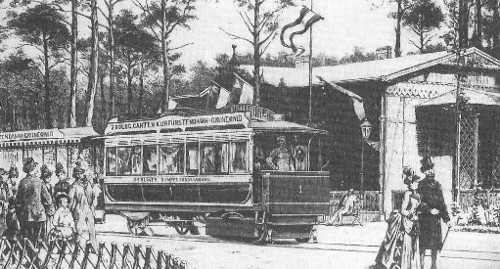
The great transformation arrived in the 19th century. Modeled after the Champs-Élysées in Paris, Berlin was to be endowed with a magnificent promenade. Chancellor Bismarck spearheaded its development, and in 1886, the new boulevard was ceremoniously inaugurated—complete with a steam tramway. Wealthy citizens quickly flocked to the area; magnificent villas and elegant townhouses sprang up. By 1913, over
100 millionaires were already living here; the Ku’damm had become a symbol of wealth and cosmopolitan glamour.
The 1920s transformed the boulevard into the beating heart of the capital. Cafés like the Café des Westens, theaters, cinemas, and the nearby Lunapark attracted artists, writers, and nightlife enthusiasts. It was the place to meet—a place where
people laughed, debated, and celebrated; the Ku’damm stood for freedom and
a zest for life.
But then came the dark era. In the 1930s, Jewish
business owners were harassed and driven out by the Nazis. The war devastated large sections of the street. The ruins of the Kaiser Wilhelm Memorial Church remained standing as a solemn reminder.
After 1945, the Ku’damm experienced a rebirth—this time as the “Showcase of the
West.” Fashion houses, cinemas, and cafés re-established it as the vibrant center of West Berlin. International guests strolled here, and momentous events took place: John F. Kennedy drove along the boulevard, students staged demonstrations, and
the Allied forces marched down it. The Ku’damm became a symbol of freedom and
the Western way of life, situated right in the heart of a divided Berlin.
Following reunification, the boulevard did indeed lose some of its former significance, as the city’s new center shifted toward Mitte and Potsdamer Platz. Yet to this day, the Ku’damm remains a name synonymous with glamour and history—a blend of luxury, culture, and a vibrant past.
Image 1: Motor car No. 1 of the Kurfürstendamm Company at the opening of the Kurfürstendamm on May 5, 1886. By unknown author – Reproduction from: Collective of Authors: Straßenbahn Archiv 5: Berlin und Umgebung (Tram Archive 5: Berlin and Surroundings). transpress VEB Verlag für Verkehrswesen, Berlin 1987, ISBN 3-344-00172-8, p. 96, PD-alt-100, https://de.wikipedia.org/w/index.php?curid=9563741
2nd Image: Kurfürstendamm at Kranzler-Eck, 1935, by Willem van de Poll – http://proxy.handle.net/10648/aea29980-d0b4-102d-bcf8-003048976d84, CC0, https://commons.wikimedia.org/w/index.php?curid=65503828
3rd Image: Kurfürstendamm, Summer 1945, by Bundesarchiv, Image 204-003 / CC-BY-SA 3.0, CC BY-SA 3.0 de, https://commons.wikimedia.org/w/index.php?curid=5371881
4th Image: Kurfürstendamm at Café Kranzler, Summer 1955, by Bundesarchiv, B 145 Image-F002774-0008 / Brodde / CC-BY-SA 3.0, CC BY-SA 3.0 de, https://commons.wikimedia.org/w/index.php?curid=5448504