Potsdamer Platz is a place where the entire history of Berlin can be told. Initially, it was merely a simple opening in the city wall—the Potsdam Gate. However, with the construction of the railway station in 1838, it evolved into a vital transportation hub connecting Berlin and Potsdam.
By the late 19th century, it had developed into a vibrant center of urban life. In the 1920s, Potsdamer Platz was the pulsating heart of Europe: Germany’s first traffic light stood here, and cars, streetcars, and crowds of people filled the streets—day and night.
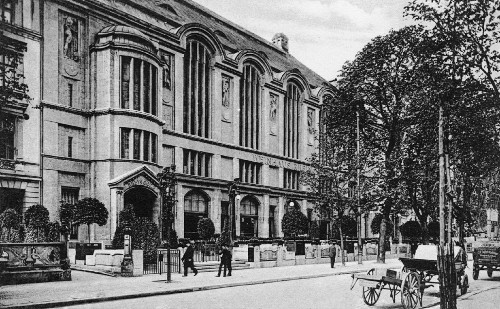
And right in the midst of it all stood the legendary Haus Vaterland.
It was a colossal palace of entertainment where visitors could wander through various themed restaurants—ranging from Viennese coffeehouse culture to a Spanish bodega featuring artificial thunderstorms, and even the Wild West. It also boasted a cinema with a seating capacity of over 2,000. Haus Vaterland was more than just a dining venue; it was an entire world of immersive experiences—a symbol of the exuberant lifestyle of the Roaring Twenties.
Yet, this splendor was not to last. During World War II, Potsdamer Platz was heavily devastated, and Haus Vaterland was gutted by fire. After the war, the entire area lay in ruins. Then, with the construction of the Berlin Wall in 1961, what was once Europe’s busiest square transformed into a desolate no-man’s-land—situated right within the border zone, inaccessible and utterly deserted.
Then came the Wende—the turning point: On November 12, 1989—just days after the fall of the Wall—one of the very first border crossings opened at Potsdamer Platz. The desolate wasteland was transformed into Europe’s largest construction site. International architects such as Renzo Piano and Helmut Jahn designed an entirely new urban quarter—featuring the Sony Center, the Arkaden shopping mall, and a skyline of modern high-rises.
Today, Potsdamer Platz is a vibrant urban hub, home to theaters, cinemas, hotels, and restaurants—with the annual Berlinale film festival serving as its undisputed highlight. And even though the Haus Vaterland vanished long ago, its legend lives on—as a symbol of the heyday of the Roaring Twenties, embedded within the eventful history of this unique place.
-
Image: Weinhaus Rheingold, view from Bellevuestraße circa 1907. By unknown author – postcard. Public Domain. https://commons.wikimedia.org/w/index.php?curid=6071552
-
Image: By Bundesarchiv, Image 102-13681 / CC-BY-SA 3.0. CC BY-SA 3.0 de. https://commons.wikimedia.org/w/index.php?curid=5481137
-
Image: 1935. By Willy Pragher. CC BY 3.0. https://commons.wikimedia.org/w/index.php?curid=81063994
-
Image: By Willy Pragher. CC BY 3.0. https://commons.wikimedia.org/w/index.php?curid=36737797
-
Image: By Michael M. Dean (Canada. Dept. of National Defence/Ministère de la défense nationale) – Library and Archives Canada does not allow free use of its copyrighted works. See Category:Images from Library and Archives Canada., Public domain, https://commons.wikimedia.org/w/index.php?curid=585407
-
Image: By Edward Valachovic https://www.flickr.com/people/fauxaddress/ - https://www.flickr.com/photos/fauxaddress/2920545866, CC BY-SA 2.0, https://commons.wikimedia.org/w/index.php?curid=5336028
-
Image: By Frits Wiarda - Own work, CC BY-SA 3.0, https://commons.wikimedia.org/w/index.php?curid=15575260
-
Image: From Avda / www.avda-foto.de, CC BY-SA 3.0, https://commons.wikimedia.org/w/index.php?curid=57709845