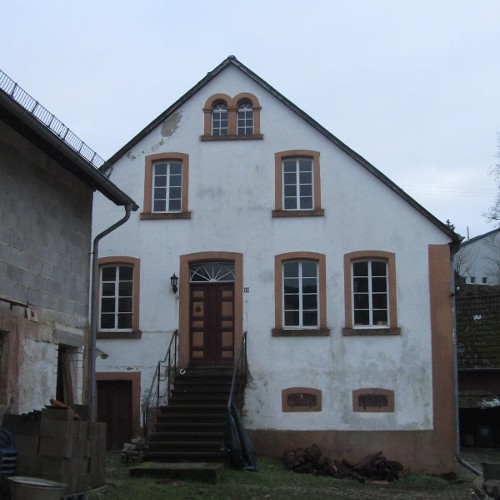
This old mill was built in 1870. Master miller Karl Jakob Jung was the first miller to live and work here. After him, his son Hugo took over the operation.
Living and working took place under one roof, but most of the building was used for the mill itself. At that time, the machinery operated on three levels. The original power source was an overshot waterwheel with a diameter of 3.7 meters, located at the rear of the building. Its grinding marks are still visible today in the water house. Three streams supplied the wheel, and two mill ponds served as water reserves. When water was nevertheless scarce, diesel engines initially had to provide assistance. Hugo Jung, however, kept pace with technological developments and installed an Ossberger water turbine in 1950, which replaced the wheel.
From there, one improvement followed another. In addition to the millstones, modern roller mills were introduced, and new machines and devices for cleaning, grinding, and sieving grain were added over time. The mill was able to continue operating until around 1980.
A very old, hand-drawn sketch clearly shows the external layout of the mill complex. It depicts the main building, the barn with stables, a lower and an upper garden, the well, and the bakehouse. Even the course of the underground masonry millrace is shown, running through the courtyard all the way to the Jettenbach.
The current owners wish to make these historic structures visible again and to preserve part of the former equipment in order to maintain the character of this listed mill.