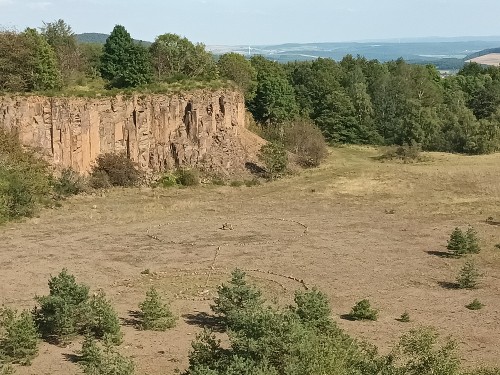
At Schneeweiderhof, a district of Eßweiler, there is an old quarry whose origins date back to the nineteenth century. It is therefore one of the oldest quarries to be found in the Kusel district.
A resident of Schneeweiderhof and former worker recounts his activities in the quarry. After finishing school, he began working in the quarry at the age of fourteen. At first, he was employed as a stone counter, loading paving stones onto the mine carts. He was also assigned to operate the cable railway that ran from Schneeweiderhof down into the valley to Altenglan. Six people were required to operate the cable railway, as five people pushed while one person opened and closed the chute at the silo to load the wagons with crushed stone or gravel. He recalls that he often stood in front of the wagons with his legs so that they would not roll away during loading. The person responsible for loading the wagons also had to push the filled wagons toward Altenglan at regular intervals.
The working day at the cable railway was long, as shifts often lasted between twelve and sixteen hours. He reports one day on which he worked from 2:00 p.m. until 6:00 a.m. the following morning pushing the cable railway. At night, he remembers nearly falling asleep while walking and already drifting into dreams, because he was not allowed to stop work until all silos were empty.
With increasing experience, he was later trained as a stone dresser. For this work, he received “good” stones from the workers who were employed at the rock face. Dressing the stones required a large container filled with soft earth, on which the stone to be worked was placed. The stone was shaped and turned on this soft surface until it became square. The tool used was a “special” hammer that was sharpened on both sides. When one side became dull from striking the stones, he had to remove the hammerhead and turn it so that the other sharp sides could be used. After about half a day, all sharpened sides of the hammer had become dull. The hammer then had to be heated in the designated forge, resharpened, and hardened with tempering powder. The handle of the hammer was not straight but curved slightly downward toward the hammerhead. This was necessary because the hammer required a certain angle for working the stones. The handle could not be purchased; instead, each worker had to find a suitable handle himself that fit his way of working. A small piece of leather was also placed between the hammerhead and the handle to slightly cushion the blows.
As a stone dresser, he worked eight hours a day. He states: “If you had good stone blocks that did not require much work, you could produce not quite one cubic meter in a day. One cubic meter amounted to about 800 stones.” Depending on demand and orders, stones of different sizes had to be produced. For example, there were 8/10, 7/9, or 9/11 stones. These numbers indicated the length of the sides a stone was supposed to have, meaning that an 8/10 stone could measure between 8 and 10 centimeters on all sides. The 8/10 stone was also the most commonly required and produced paving stone. “I believe,” the worker recalled, “that paving stones like these can even be found in Paris.”
When the quarry was modernized in the 1950s, he eventually became a driver of the transport vehicles. He remained in this position until the quarry closed in 1970.