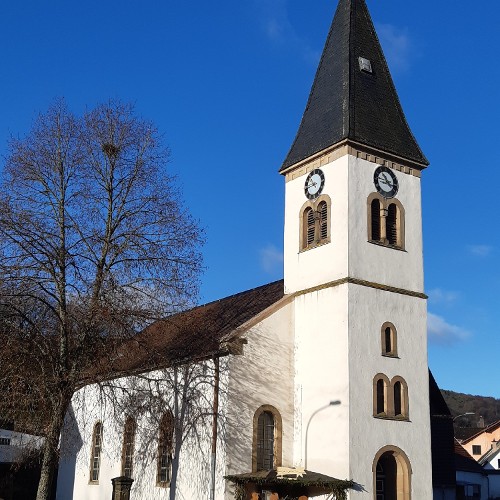
One might assume that stone altars are immovable objects that never go on journeys. That this is not always the case is something the altar of the church in Essweiler could tell us.
Our church stands in the center of the village and received its present appearance in 1865. Since the roof turret of the previous building was structurally unsound, it was replaced in 1865 by a four-story tower, and a polygonal choir was added on the west side. A sandstone altar was also installed there. In this form, the church stood for about one hundred years. At the end of the 1960s, it was decided to carry out a major interior renovation of the church. During this process, it largely acquired its present appearance. At least almost, because in the eyes of some observers the old sandstone altar now seemed out of place and was quickly replaced by a simple wooden table painted in the colors of the interior.
However, only a short time later the congregation wished to have its old altar back. But where had it gone? Inquiries were therefore made, and fortunately they were successful. The altar was located in the Palatinate Forest on a property near Schmalenberg that belonged to the then dean, Welker. After consulting with him, it was finally agreed that the altar should be brought back to Essweiler.
The exact course of the retrieval operation is no longer easy to reconstruct today. What is certain is that the presbyters at the time, Hugo Walter, Karl Gilcher, and August Metzger, set out for Schmalenberg. Two cars, together with a livestock trailer belonging to master butcher Günter Dick, who also took part, headed toward the Palatinate Forest. The work on the property was completed quickly, and the altar, dismantled into individual parts, was soon safely loaded onto the trailer. There was even time for the helpers to make a stop on the return trip at the Scholl Inn in Schwedelbach to have something to eat. Günter Dick had brought several ring bologna sausages along for the journey. Well fortified, they then set off on the final miles to Essweiler and made a ceremonial arrival with the altar.
The individual parts of the altar were reassembled and placed in the choir, where it still stands today.