The first known mention dates from 1333: in a partition charter of the counts, “the mill at Eßweiler” is recorded. Later, in the sixteenth and seventeenth centuries, there were no professional millers here. Instead, farmers operated communal Pletsch mills—simple installations with overshot waterwheels and a single milling mechanism. Because the streams carried little water, operations often came to a halt during the summer months.
An inspection carried out in 1606 describes the Eßweiler mill as being “near the upper part of the village,” with so little water available that it frequently stood idle. During the Thirty Years’ War, the mills of the valley were destroyed. The Eßweiler mill continued to pay rent until 1634 and probably ceased operation only after that date. In 1662, the municipality requested permission to rebuild the mill, which was granted. Several villagers were authorized to reconstruct it at their own expense and to pay rent.
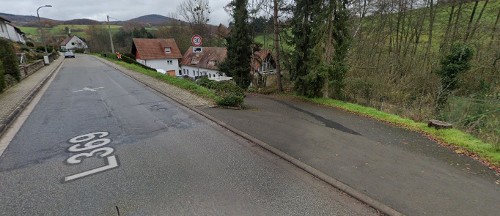
Around 1743, two mills are documented in Eßweiler: the village mill in what is now Mühlgasse and the “mill above Eßweiler” on the Jettenbach—our Upper Mill. For a long time, it was considered a separate hamlet. Until the 1970s, it lay about 500 meters outside the village and has survived to this day, now serving as a residential building.
By the late 1970s, remnants of the technical equipment were still visible. These included metal rods and belt pulleys in the cellar, bearings mounted on large stone blocks, a sack hoist in the upper floors, and a narrow shaft for a waterwheel that had once been located inside the building. The property also included a mill pond situated at a higher level and a millrace fed by the Rammelsbach. Parts of the weirs can still be recognized today. The large millstone was later used as garden decoration and has since disappeared.
As you now look at the house and its surroundings, imagine the sound of rushing water, the slow turning of the wheel, and the steady grinding of the stones. For centuries, this was the sound of work and everyday life here.