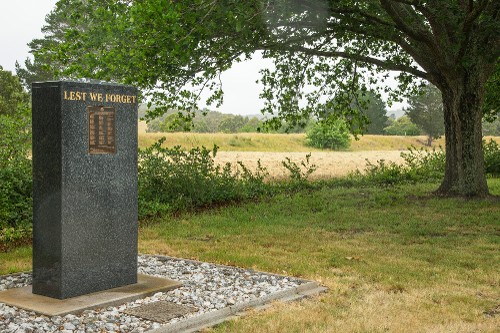
The Avenue of Honour, originally consisting of 100 alternating oaks and elms, was planted in July 1918 to commemorate the Linton men who enlisted to fight in the First World War. Denison Street was chosen as the appropriate site as the railway station was the main entry to the town in this pre-car era.
Each tree had a name plaque representing an individual soldier, but these were apparently removed in the 1950s and are now lost. Grenville Shire Council also removed most of the elm trees (evidently in the 1930s) because of problems with suckering on adjoining properties. Today only 44 oaks and 4 elms remain.
Several railway employee’s houses were situated along this street and John Dawe’s second shop was situated on the west side of Denison St not far from the railway entrance, serving the needs of rail travellers.
On Anzac Day 2009, the Linton and District Historical Society unveiled the monument in the centre of the Avenue to commemorate the 90th anniversary of the Avenue’s planting.
In 2022, the Society obtained a grant to commission a sculpture of Dr Vera Scantlebury, born in Linton in 1889. In 1917, Vera travelled to London and joined a team of female doctors at Endell St Military Hospital, a hospital created and staffed by women and run for the British Army. For two years, Vera worked as a surgeon treating injured soldiers being sent over from France.
Back in Melbourne, she subsequently became the inaugural Director of the newly formed Infant Welfare Department in the State Government Department of Health. In 1938 she was awarded an OBE for ‘distinguished work in preventative medicine’.
A full account of Vera’s life and work is provided by accessing the QR code attached to the plinth here.
Go up the Clyde Street hill and you will return to the corner of Sussex Street and the end of this tour.